Showing posts with label the way forward. Show all posts

Sunday, July 22, 2012

Individual Right to Bear 1791 Arms

In the shadow of the horrible, yet not shocking, tragedy in Aurora, Colorado, I keep thinking back to my proposal on the topic back in November 2007.

So long as SCOTUS is going to find that the Second Amendment is an individual right to bear arms (not a reaffirmation of the militia right), my view remains that the most workable solution for the demands of our modern society is some rather extreme originalism and federalism — the Second Amendment should protect an individual right to bear as such arms existed at the time of the ratification.

Let the states choose if they want to have gun rights beyond this basic backstop.


November 27, 2007 Sauntering - The Right to Bear Ye Olde Arms

Wednesday, December 08, 2010

Lennon's Loss

I'll admit that I'm a sappy, emotional guy. Once in a while, I'll settle into work, only to stumble across something on the web that hits me like an emotional ton of bricks.

This short New York Times piece on the 30th anniversary of John Lennon's death is not memorable for its contents — it's memorable for the hundreds of reader comments that follow the piece. It's page after page of short, detailed remembrances, each intimate and sketching a scene of shared yet private grief at the loss of this light.

I was 4 in 1980, so my grief at Lennon's loss wouldn't come until later.

Dried flowers from the funeral of Abraham Lincoln.
Ford's Theatre National Historic Site, Washington, D.C.

Tuesday, January 20, 2009

I Can't Believe That Today Has Come

I'm a fan of the alternate history genre of fiction, because it forces us to look at history as a malleable and flexible thing. Sure, this country averted disaster when the Cuban Missile Crisis was resolved, but what would have happened if it had not been resolved? What would have happened to the world if World War II had resulted in a different outcome, or if the U.S. Civil War had turned out differently?

Looking at major world events and the aftermath they wrought, it is clear that history is a close question. The world that we know is the result of individual conversations that happened (or didn't happen) between people whose actions determined the shape of our reality. Things could very easily have gone another way.

I'm reminded that I think that our world could easily be a vastly different place today because today is the inauguration of Barack Hussein Obama as the 44th President of the United States. I simply cannot believe that this day has come.

It's as if we've been suddenly pulled into an amateur alternate history that defies all belief. We have, apparently, elected the right person for the right time — a professorial, wise individual with a complex worldview for complicated times. Yet, more amazingly, we have elected an African-American man whose mother was only 18 when he was born, a man whose father was Kenyan and left his mother, a man whose first and last names are so unique to an American ear that Al Sharpton mispronounced them during the 2004 Democratic National Convention, and a man whose middle name evokes fears about a recent U.S. enemy.

I cannot believe today has come.
     I cannot believe today has come.
          I cannot believe today has come.

And it is wonderful.

Saturday, January 05, 2008

Two Laptops, No Children


Just a few months after One Laptop Per Child (OLPC)'s triumphant launch, the effort has been dealt a major blow: Intel has withdrawn its support for the program. This is the latest in a series of difficulties the program has faced — it had already doubled its price-point goal of $100 and drastically lowered sales expectations due to unexpected competition.

Technologically and financially, Intel's support is not critical to the success of OLPC; it runs on an AMD chip, and the company had only made good on a third of its promised $18 million donation. No, the real problem is that the dispute arose over Intel's Classmate PC. The Classmate is, arguably, a well-designed classroom computer that governments appear to prefer to the OLPC. Depending on which account you read, the arrangement fell through either because OLPC wanted Intel to abandon the Classmate or because Intel's sales organization was intentionally undermining the OLPC.

If you care about OLPC's mission, which is more accurate doesn't really matter. The real problem is that while most accounts have suggested that the Classmate and the OLPC are head-to-head products (along with the Asus Eee PC), that isn't the case. The OLPC is a fundamentally new product, whereas the Classmate and the Eee PC are not. While the latter two are, at best, very well built laptops that are affordable for developing countries, the OLPC is a very well built educational tool that is designed to serve developing countries.

Consider:

  • The OLPC was designed to be run where electricity is a scarce and unreliable commodity: running for 5 hours — potentially twice that in ebook mode — on a full battery (the Classmate runs a typical 2-4 hours) and rechargeable by hand.
  • The OLPC automatically creates a mesh network in the presence of other OLPCs and can detect WiFi signals up to 2 kilometers away (compared to standard WiFi on the Classmate).
  • A core capability of the OLPC is eToys, a game-like, graphical, educational programming environment (on the other hand, the Classmate can run Office!).
Having experienced the local school board's decision to switch from Mac to Windows when I was in high school, based on the well-intentioned but utterly false supposition that learning on Windows better prepares one for a Windows-based workplace, I am not surprised that governments are choosing the Classmate. Who wouldn't choose the machine backed by a multibillion dollar company, running the software that every other country runs?

But if you're a kid in Iraq, where the electricity is on 8-12 hours a day, or Afghanistan, where "normal" Internet access is only available via satellite, which laptop would you want?

Thursday, December 27, 2007

Nur noch wir können uns retten. (t)

Hearing the sad news of Benazir Bhutto's assassination in Pakistan earlier today, I looked back at my reaction to the London bombings of July 7, 2005.

It isn't yet clear who is directly responsible for today's slaughter, but initial indications are that those behind today's attack are of the sort who share goals in common with the London bombers and with other bombers whose actions have scarred the world during the past decade.

Reading my London bombing post 903 days after I wrote it, it's clear that at the time I greatly underestimated the potential for intra-Iraqi and jihadist violence during the intervening 2 ½ years. Looking back, I realize that my intuition that the violence would quickly flame-out stood in contrast to the basic thesis of the post, that – in the long run – it's all but impossible for groups of people to force a De-Enlightenment upon the world, even if the short run shows little progress toward reducing global ignorance and provincialism. 2 ½ years later, on a dark day when apparent extremism wounded the hope of a country, I still feel that the horse is out of the barn for extremist views, though extremism and responding to extremism might be the most dominant geopolitical forces during my lifetime.

Despite my opinion that the extremist's struggle is ultimately for naught, events like today still depress me greatly. Somehow, the depression of today reminds me of the dark words Martin Heidegger said in his famous interview with Der Spiegel in 1966 (published posthumously in 1976), titled "Nur noch ein Gott kann uns retten" or "Only a God can still save us":

HEIDEGGER: Those questions bring us back to the beginning of our conversation. If I may answer quickly and perhaps somewhat vehemently, but from long reflection: Philosophy will not be able to bring about a direct change of the present state of the world. This is true not only of philosophy but of all merely human meditations and endeavors. Only a god can still save us. I think the only possibility of salvation left to us is to prepare readiness, through thinking and poetry, for the appearance of the god or for the absence of the god during the decline; so that we do not, simply put, die meaningless deaths, but that when we decline, we decline in the face of the absent god.
I agree with Heidegger in the view that there's no one philosophy, mode of being, or way of life that will unite humanity under a single banner, smoothing out the cultural differences. Yet – and I haven't studied enough Heidegger to know if he'd disagree with me on this point – it's precisely this diversity and intellectual disunion that promises to save us.

The global proliferation of pluralistic cultures, whether through the gradual introduction of democratic institutions or through the rapid technological baptism of individual citizens into a connected world, forces an increasing percentage of world citizens to an important daily realization. The realization is as follows: There are other ways of coping with the world that differ from mine.

Certainly, most greet this realization with fear, and some greet this realization with violence.

Yet, from this first exposure, can there be anything but eventual tolerance?

From that eventual tolerance, can there be anything but eventual intolerance for the ancient intolerance?

Tuesday, November 27, 2007

The Right to Bear Ye Olde Arms

(Crossposted from American Constitution Society :: Columbia Law School)

The ACS/Federalist Society sponsored discussion/debate on DC v. Heller – the first SCOTUS case since 1939 to address the meaning of the Second Amendment – won't begin for another 2 hours, but I am prepared to upstage the speakers by offering a workable solution for Second Amendment jurisprudence in the 21st Century.

Although the language of this amendment provides infinite grist for the mill of constitutional interpretation, my solution focuses exclusively on one word: arms.

My proposal: The Second Amendment protects an individual right to bear arms as such arms existed at the ratification.

Arms in 1791

Let's look at arms – specifically, guns – as they existed at the time of the ratification.

Guns in 1791 WOULD
Guns in 1791 WOULD NOT
Courts can't wish the Second Amendment away, but they can construe it in a manner that works in today's society.

Arthur Goldberg, the little-remembered Supreme Court Justice who sat on the bench from 1962 to 1965, has been long-derided by social and political conservatives as something of a fool due to his concurrence in Griswold v. Connecticut, where he found a right to privacy in the Ninth Amendment. Lately, these same conservatives have been quoting and paraphrasing Justice Goldberg when they say things like "while the Constitution protects against invasions of individual rights, it is not a suicide pact," a line Justice Goldberg included in Kennedy v. Mendoza-Martinez, 372 U.S. 144, 159-60 (1963). Applying an admittedly severe form of originalism to cabin the Second Amendment prevents the kind of suicide pact that Goldberg was worried about.

Michelle Obama created a bit of a stir earlier this week when she talked about how the need for guns might vary regionally within the United States. A backstop interpretation of the Second Amendment – one that only protects the individual right to bear arms as they stood in 1791 – permits states to develop right to bear arms appropriate to their circumstances.

Monday, November 12, 2007

One Laptop Per Child: Give One. Get One.

Back in 2005, I was at the conference in San Francisco where Nicholas Negroponte first announced that he and others at the MIT Media Lab intended to sell a laptop for $100 with the goal of putting a laptop in the hands of every child the world over.

That mission has since become One Laptop Per Child, an organization that has just started manufacturing these machines for use around the world. Rather than describe at length the wonders of this little machine, I encourage you to watch this review from the New York Times' inimitable David Pogue.

On the theory that this machine is targeted at the developing world and that sales to rich countries would unduly divert computers away from kids who desperately need these devices today, it's going to be pretty difficult for you to get your hands on one. That's right, you can't buy one.

Well, that is, starting in two weeks you can't buy one.

For the next 15 days, you can buy one of these remarkable machines through a program called "Give One Get One." For $400, you can buy a laptop and pay for a laptop to go to a child in the developing world. As a bonus, you'll get a one year subscription to T-Mobile's Hot Spot service. (As Amos pointed out to me, the T-Mobile promotion, which can be used on any wifi-compatible device, appears to have a retail value of $360.)

Thursday, October 18, 2007

Radiohead's In Rainbows:
Online and Available for Free
(or for Whatever Seems Fair)

Absurdly talented rock band Radiohead is a band unencumbered by a record contract. Thus, they can do great things like offer their new album In Rainbows available for download directly to their users without having to ask anyone's permission.

Since Radiohead gets 100% of the proceeds of the record (instead of the meager slice they'd get from a deal with a record company), they're comfortable letting users download the record and name their own price. Grab it for free if you'd like. I paid £5.00. That seemed fair.

The tracks don't have any accompanying cover art. Make you own art or obtain the Radiohead-blessed art here if you'd like to have something pretty staring back at you when you listen to the track on your music player.

Monday, September 24, 2007

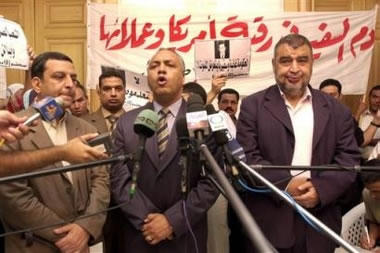
Ahmadinejad & Academe

At the end of the Columbia Hillel Reform Kol Nidre (Yom Kippur) service, the rabbi urged all the congregants to join the protest Monday against Mahmoud Ahmadinejad, the president of the Islamic Republic of Iran, whom Columbia University's School of International and Public Affairs is hosting for its annual World Leaders Forum.

At the time, I generally agreed that protesting Ahmadinejad was worthwhile. Ahmadinejad denies the Holocaust, calls for destruction of the State of Israel, and generally holds odious and illiberal beliefs on many subjects. Furthermore, he is in a position of political power to effectuate at least a subset of these despicable beliefs into action.

Ah, but the protest is only partially against Ahmadinejad. Most of the rhetoric seems to be directed against Columbia University for allowing Ahmadinejad to participate in the World Leaders Forum.

The main argument against Columbia's action (or inaction, depending on how you view the events) is that providing Ahmadinejad with a forum at Columbia University either (1) implies academic or Western endorsement of his beliefs, or (2) legitimizes him as a political figure. Andy's post effectively addresses the second prong, so I will address the first.

Despite various disclaimers by Columbia President Lee Bollinger that Ahmadinejad's participation does not amount to a University endorsement of his views, the millions of people who hear of this event will likely fail to make this distinction, and may think more highly of Ahmadinejad or his beliefs than before. Even though the University interlocutors promise to "sharp[ly] challenge[]" Ahmadinejad, the simple granting of a forum to some extent implies that his beliefs are worth challenging.

The critical difference, as I see it, is that Ahmadinejad is not simply a layman who holds such beliefs. In other words, he is not "a Grand Wizard of the KKK who called for African nations to be wiped off the map." He is being invited because he is the leader (more accurately: second in charge) of a large and influential nation. If Ahmadinejad were just a shopkeeper in Tehran, Columbia would really have no business inviting him.

But even in this last case, I think Columbia should still have the right to invite him. This is a question of academic freedom. Specifically, it raises the following question: Are there people whose beliefs or actions are so odious that they should be forbidden from speaking at a university? This is a tough question, but I'm inclined to answer No.

As Mike Dorf has pointed out, refusing to allow some people to speak would imply university endorsement of everyone else who speaks. Since drawing the line once would mean having to draw the line forever, from a pragmatic standpoint it makes sense to adopt a hands-off approach.

At bottom, however, it comes down to how much one values the special position of the university in intellectual discourse. Yes, there is a danger that Ahmadinejad may gain in influence by participating in this event (though unlikely to gain much from the one person who matters: Ali Khamenei, the Supreme Leader of Iran), but academic self-censorship is more dangerous precedent. Most ideas are odious to someone. If universities are closed to ideas that lack a consensus, where can they be subject to rational criticism?

We have the powerful institutions of diplomacy and the military to oppose Ahmadinejad's implementation of his ideas outside the borders of Iran. What do we have to prevent the spread of academic self-censorship outside the borders of Columbia?

Ahmadinejad on Campus

Entering the Columbia campus today was no small feat, as the subway entrance outside the gates ejects you into a security cordon. The Columbia campus, a 6-square-block quad, is sealed off except for the two main gates. After presenting my Columbia ID card, I made my way to the law school, passing through a locked-down campus littered with the indicia of a protest-to-come.

New York civic leaders of all stripes are up in arms at Columbia welcoming Ahmadinejad to campus, some threatening to find economic ways of harming Columbia. Yet New Yorkers have had to do their cosmopolitan duty and entertain ghoulish figures since the dawn of the U.N., and my words to those who oppose his presence at Columbia – not to those who oppose him through their questions and remarks at the event or to his ideas through their protest signs – is the same as Josh Marshall's reaction to the Ground-Zero-visit opposition: Grow Up.

The Islamic Republic of Iran has been around for almost 30 years — whether its 2nd in command is invited to face U.S. students or not doesn't really matter when questions of legitimacy come up. It's not a question of legitimizing a less-than-democratically-elected leader. It's a question of dialoging with a presence on the world stage that won't go away, however much we choose to avoid diplomacy and dialogue.

Lost in the furor over the Ahmadinejad visit are two interpretational lenses that I find instructive.

First, it was almost a year ago that supporters of the Iranian progressive movement were heartened by the vocal opposition that met Ahmadinejad when he spoke to students at Tehran's Amir Kabir University. I was elated that Ahmadinejad met vocal opposition then, and I hope he meets vocal opposition today. If I could engineer society so that he met vocal and informed opposition every day, I would.

(In this sense,
Ahmadinejad's interlocutors inside the auditorium serve roughly the same purpose as the protesters outside the auditorium. But for Ahmadinejad coming up to Columbia, how would he ever encounter those strenuously opposed to his message?)

Second, our country needs many things, but it especially needs to reacquaint itself with civil debate, even if it looks like civil debate with monsters. For 7 years, we have suffered under a President who appears afraid to face his opposition. This is a problem. Just as the UK's Prime Minister must face bombardment every week during Prime Minister's Questions, we should demand a society where political views of all stripes engage opposing ideas, even if those opposing ideas sound odious in the extreme.

Monday, June 11, 2007

My Teacher, Richard Rorty (1931 - 2007)

One of my friends has a strange job. He works for a broadcast television network, crafting obituaries for people who are still alive. Now, as I try to cobble together a few words on Richard Rorty, the person who changed the way I see the world more than anyone else (outside my family), I realize why they write these things ahead of time.

I'm going to write about the second time Richard Rorty changed my life.

The first time, it was 1998 and I was a college senior taking a year-long course from Rorty during his first year at Stanford. The course listing indicated that by taking the class I'd get the chance to reacquaint myself with the Western canon. Instead, what I learned was that I wasn't the only person who cherished religion without living a life of belief, that a school of thought called pragmatism echoed many of the ideas I'd stumbled across in philosophical Taoism & Buddhism, and that Theodore Roosevelt more or less captured the meaning of life when he said "Do what you can, with what you have, where you are." (In class, I once asked Rorty what he felt the meaning of life was. I distinctly recall his answer: "To envisage new modes of being." Let's stick with Roosevelt.)

That was the first time. This is the second time:

The last time I had a long talk with Richard Rorty was October 2001. I was a struggling entrepreneur, back at Stanford half-time to finish my masters degree while the company I helped found was itself foundering (It would miraculously recover). I was taking a graduate course with Rorty – I think it was called Kant, Nietzsche, & Heidegger – and I paid him a visit in his office. I remember the conversation like it was yesterday.

As it was early October 2001, we started the conversation the way all conversations began in early October 2001. We talked about 9/11.

I asked Rorty if he'd written anything about 9/11. He said that he had not, but that he suspected American culture would react to this shock the same way it had reacted to similar shocks before — with xenophobia and a temporary loss of civil liberties. I was still in my post-9/11 complacency. Rorty was not.

Rorty was unflaggingly patriotic but despised chauvinism, recognizing that it's the latter that passes for patriotism today. In his brief 1994 essay The Unpatriotic Academy, Rorty (a lifelong leftie) criticized his fellow academic lefties, expounding a view that others would later condense into the t-shirt/bumper sticker slogan Dissent is Patriotic:

There is no contradiction between such identification and shame at the greed, the intolerance and the indifference to suffering that is widespread in the United States. On the contrary, you can feel shame over your country's behavior only to the extent to which you feel it is your country. If we fail in such identification, we fail in national hope. If we fail in national hope, we shall no longer even try to change our ways.
The obligatory 9/11 discussion out of the way, we moved on to other matters.

Mainly me.
...and my life.
...and me not knowing what to do with it.

It was 2001 and I was completing my second degree in Religious Studies. I knew enough to know that I didn't have the desire or the talent to get my PhD. Having been pulled into 1999's online tulip mania, I had about 2 years of experience with technology startups, but did I want to be the guy with the Religious Studies degree, pretending to know Thing One about how to build The Next Big Thing? Here I was, about to ask Richard Rorty – the most subtle, inspiring mind I'd ever met – what to do with my life.

(I know I said I remembered this conversation like yesterday, but things get a little hazy here. Rather than bore you with "and then I said" followed by "and then he said," I'll just fast-forward to way I felt at the end of the conversation.)

Leaving his office, I knew I had just lived through a Eureka moment. I felt physically changed. I'd felt great before, I've felt great since — but I'd never felt quite like this. As I bid Rorty adieu and descended the interior steps of Building 260, I reflected on these ideas that had hit me like such a freight train.

Long before this conversation, Rorty convinced me that it is pointless to pretend that there is some unique thing called philosophy — I recall him characterizing it as little more than "boring poetry." Although statements like this earned Rorty more than his share of academic enemies, few would dispute the assertion that the best painters, the best writers, the best thinkers, the best musicians do little more than introduce us to new modes of being. Their fields are more similar than they are different. They all show us a glimpse of what is possible.

I'll never forget what I thought as I walked down those steps: The Law is simply the social laboratory in which ideas do battle. To become a lawyer is to become someone who is a tiny part of a gigantic idea project. A lawyer's job is to sculpt ideas as people change and sculpt people as ideas change.

I went home and told my surprised girlfriend – not yet my fiancée – that I had an epiphany and was going to law school. The following summer, I took the LSAT exam. That fall, I applied to a few law schools. I deferred law school for two years until that girlfriend – by then, my wife – finished her own law schooling. In 2005, that girlfriend/fiancée/wife and I moved to New York, and I started law school.

Now, almost six years after talking to Richard Rorty, I believe more firmly than ever that the lawyer's role is to shepherd ideas through society and society through ideas. I'm working at a law firm that guides startups, startups like the one that I worked at when I talked to Richard Rorty in October 2001.

Richard Rorty died on Friday at age 75. A few years ago, he changed my life. Thank you, Rorty. Thank you for changing my life.

Thursday, April 19, 2007

Refusing to Defend the Indefensible

No reader of this blog will be surprised to hear that I consider myself to be a political & cultural liberal. Still, it's easy for me to identify a handful of conservative voices whom I treasure. Leading the pack are David Brooks (presently/formerly referred to as "every liberal's favorite conservative," NY Times columnist) and Andrew Sullivan (former editor of The New Republic, blogger, author of The Conservative Soul: How We Lost It, How to Get It Back).

Other than strong writing, the thread linking Sullivan & Brooks in my mind is a capacity to be critical of the broader political & cultural conservative movement. Surely part of the attraction of having a conservative criticize conservatism is that it saves liberals from doing all the work, but that's not the half of it.

A larger part of my attraction to these writers' work is their refusal to close ranks and stand shoulder-to-shoulder with other self-identified conservatives when doing so would require them to compromise their views. After what this country has recently been through, this is a trait all liberals should value.

I say nothing controversial at all when I say that many of the self-inflicted injuries wrought upon this nation during the past 6+ years have been exacerbated by dissenting or skeptical members of the controlling party/ideology either supporting or refusing to oppose decisions made by other party/ideology members. Fortunately for us, as frustrating and painful as this past historical period has been, it appears we're entering a new era with a different set of rules regarding toeing the ideological line.

The American voter's rejection last November of the conservatives-united-will-never-be-divided approach is starting to bear fruit, and public dissent among conservatives has returned to the public forum. Although this public conservative dissent is now no stranger to the airwaves, I wanted to cheer you with a less-known bit of conservative dissent that cheered me today.

A bit of back story: The Corner is a blog run by the National Review, a magazine founded by William F. Buckley in 1955 and lately accused by voices on the left of chickenhawking — that is, offering civilian commentary (from commentators who have never served in the military) in strong support of an aggressive interventionist military strategy. Of late, I've become a bit addicted to The Corner, if for no other reason than to learn more about how the current crop of neoconservatives see the world.

On the day after the Virginia Tech tragedy, and in the spirit of a true chickenhawk, one of the National Review bloggers, John Derbyshire, wrote a post blaming the victims of Monday's attack for the enormity of their own suffering. "Where was the spirit of self-defense here?" asked Derbyshire, wondering how a lightly armed person could kill so many. Apparently, Derbyshire was certain of his own courage when similarly situated.

Over the past four days, me-too conservative pundits have tried to reframe the debate about Derbyshire's words, engaging in all manner of apologetics and trying in vain to turn blaming the victims into something other than blaming the victims. Finally, today, another National Review blogger, John Podheretz, stood up to Derbyshire's accusation. "I have to dissent, in the strongest possible terms, from John Derbyshire's shocking posts on Virginia Tech," Podheretz began, launching into a blistering critique of his colleague's view.

I'm not accustomed to National Review writers dissenting amongst themselves in the "strongest possible terms," and I was well pleased — not pleased that I found one more conservative voice to consistently enjoy (JPod's not really my cup of tea), but that I witnessed a conservative voice stand up to another conservative voice when it would have been easier for him to attempt to excuse his colleague's poorly-conceived comments or just to look the other way.

Thursday, February 09, 2006

Worth Your Time: Podcast of Richard Rorty on KQED's Forum

My favorite thinker & teacher, Richard Rorty, was interviewed by Michael Krasny on 1/31/06. The podcast is here. (iTunes link)

Harold Bloom calls Rorty the "most interesting philosopher in the world today," but I agree with Rorty. If you're attempting to talk about a distinct human activity easily distinguishable from other literary traditions, there is no such thing as philosophy.

Wednesday, January 04, 2006

Is That a Mouse in Your PC Card Slot, Or...

I know, it's easy to be too much of a gear fetishist; however, you've gotta admit that a mouse that recharges in the PC card slot on your laptop is pretty cool.

Friday, November 04, 2005

Kiva: Forget Teach a Man to Fish — Loan Him Money For a Fishing Net

If you don't know about microcredit, you should.

After the Bangladesh famine of 1974, a group called Grameen Bank developed the microcredit model. Microcredit is the practice of granting small, business-enabling loans to people so poor that they would not qualify for conventional credit.

The Economic and Social Council of the United Nations proclaimed the year 2005 as the International Year of Microcredit, and the good news is that you can help this incredible movement — personally.

A friend of mine, Matt Flannery, has started Kiva, where you can personally loan money to individuals in the developing world who are bootstrapping their way out of poverty.

Currently, Kiva allows an individual to loan to another individual in Uganda. The terms of the loan (which can be as small as $25) are such that you are paid back in a 6 or 12 month term. You also get monthly updates about payment info and blog like updates containing business info. To date, Kiva has started 7 businesses in Uganda, including a fish mongerer, some butcher shops, and a clothes reseller.

Signing up with Kiva is easy, so get started today.

Comedian Greg Giraldo's act has a bit that goes something like this:

People say you shouldn't give homeless people money because they're just going to spend it on drugs or booze.

Well, that's actually what I was planning on spending it on, so what's the difference?
Kiva presents an opportunity to break out of that dilemma in a way that promotes lasting, global change for a pretty small amount of money.

Thursday, July 07, 2005

You Can Never Go Home Again

This morning, likely guided by a political, cultural, and religious vendetta, a group of people committed murder in London. The London Mayor Ken Livingstone described the situation best, saying this behavior isn't an ideology, it isn't even a perverted faith, it's mass murder.

Last week, Woody Allen commented about 9/11 to the German magazine Der Spiegel. Asked why he hasn't commented on September 11 in film, Allen remarked that as a filmmaker, he wasn't interested in 9/11 because, if you look at the big picture, the long view of things, it's too small, history overwhelms it. Though I disagree with Allen's further explanation of this opinion, I share the underlying sentiment.

I cannot shake the feeling that these cruel acts are but the death rattle of a doomed mode of being. The hopes of these fiends — that the world (or portions of it) can somehow unliberalize — not only will not be realized, but cannot be realized.

Within western society, a big part of Post-Enlightenment history has been a rather Hegelian expansion of who's invited to society's party. White male landowners, white males, white females, males, females, former slaves, immigrants, gays, the poor — our current history is a process of granting Ordinary Person status to every increasing classes of people.

Outside of western society, one fruit of globalization has been the step-by-step dispersion of the notion that all members of a society are due the general respect previously afforded only the most accepted and select members of that society.

Source: AP

As they discover that the dreams of the Jihadists are not their own, Iraqi Sunnis living in border regions are learning that the enemy of my enemy is not my friend — not when that false friend orders women to wear all-enveloping scarves and robes, forbids young men from wearing Western clothes, and closes stores that sell music and satellite dishes. Habits die hard when those habits help people feel ordinary.

Whereas Iraqi insurgents wage a diminishing homeland rebellion,the cultural war waged by foreign jihadists is against all comers who lack their worldview. Witness the recent battles between Sunnis and Jihadists near the Iraqi border. Witness the enmity these jihadists hold, even for potentially sympathetic Arab countries.

Source: AP

The shadow's clutch on human minds has reigned since we first scrawled the buffalo on the cave walls. Many more will sadly die at the slaughterbench of history as the shadow retreats into the cave from which it came. Our present suffering aside, the dreams of those who would shrink the set of Ordinary People cannot be realized. We've come too far. We've seen too much. We can never go home again.

The long run is a misleading guide to current affairs. In the long run we are all dead.
John Maynard Keynes

Sunday, July 03, 2005

Human Possibilities

Much of what I write about here at Sauntering concerns connecting dots.

I encounter something online,
I encounter something else,
I piece the two together while walking the dogs,
I write a bit.

Last week, I stumbled across a couple news items that highlighted for me the scope of human possibilities and human potential.

On one hand, I read the inspiring words Steve Jobs delivered at the Stanford University graduation on June 14, 2005. Though his comments are worth reading in full, one passage in particular caught my attention:

When I was 17, I read a quote that went something like: "If you live each day as if it was your last, someday you'll most certainly be right." It made an impression on me, and since then, for the past 33 years, I have looked in the mirror every morning and asked myself: "If today were the last day of my life, would I want to do what I am about to do today?" And whenever the answer has been "No" for too many days in a row, I know I need to change something.

Remembering that I'll be dead soon is the most important tool I've ever encountered to help me make the big choices in life. Because almost everything – all external expectations, all pride, all fear of embarrassment or failure - these things just fall away in the face of death, leaving only what is truly important. Remembering that you are going to die is the best way I know to avoid the trap of thinking you have something to lose. You are already naked. There is no reason not to follow your heart.
On Monday, the other side of human possibility came into full view in Wichita, Kansas, as BTK killer Dennis Rader gave a monotone tutorial on the banality of evil. I made it about 30 seconds into the video linked from this article. Regretably, sometimes I find it difficult to watch as the worst facets of humanity are brought to light. It feels like I'm staring into the sun.


Sunday, May 22, 2005

After Two Jail Terms, Society Blesses the Letourneau/Fualaau Union

Mary Kay Letourneau, 43, recently wed her former student Vili Fualaau, 22.

Ms Letourneau did a couple turns in the slammer for conducting a sexual relationship with Mr Faulaau when she was a 34-year-old married mother of four and Fualaau was a 12-year-old elementary school student.

...and yet gay marriage is illegal in the US — since allowing gay marriage would somehow harm the sanctity & dignity of our holy matrimonial bonds.

Saturday, May 14, 2005

Public Persona, Private Time

I have a theory: Most of the people who are famous are famous as a result of their work. As a result of this job-fame, they are strongly encouraged to A) Work quite a bit and B) Maintain precious little division between their work and home lives. As a result, success's unique ability to ruin lives has been well-documented since antiquity.

Therefore, I'm conflicted when a celebrity decides to hang up the spikes or abandon their creation. On one hand, since I suspect that 99% of these people are extremely overworked, I feel that I should be happy if they develop a life in which they walk at a more leisurely pace. On the other hand — especially if I'm a fan of their work — I hate to see them go. I'm particularly conflicted when someone like Garrison Keillor (who, to me, symbolizes a relaxed pace of life) has open heart surgery and then promptly returns to work.

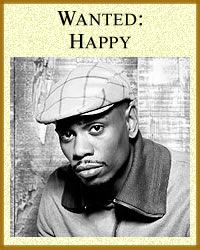
With this as a backdrop, I want to tell you that Dave Chapelle has fled the country. He has taken leave of his show and his responsibilities and gone to South Africa. I'm not kidding.

I want him back.


Dave, when you're ready, please come back and make me laugh until I need to use an inhaler. We miss you. If you get the chance, please visit Lesotho while you're there. I've always wanted to visit a country that is completely contained within another country (...though I've been to Vatican City, I don't think that really counts).

Saturday, April 30, 2005

Please Stop Hurting America

"It's not so much that it's bad, as it's hurting America ... Stop, stop, stop, stop hurting America."
Jon Stewart, referring to CNN programming while on Crossfire
A bride is on the run in America. If you listen closely, you can hear the cable news producers popping open champagne in their control rooms. As of this morning, they know the headline story that is going to eat up hours and hours of programming for the next week.

You might think the American media is completely incapable of adequately covering the world events while a People/Us Weekly-level tabloid drama is unfolding. Sadly, it's a choice. They can cover important domestic and world events even while:

A) A bride is on the loose.
B) A cat is in a tree.
C) A celebrity is kissing another celebrity.

...they just choose not to do so.

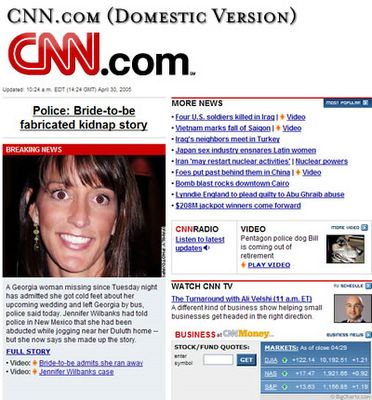
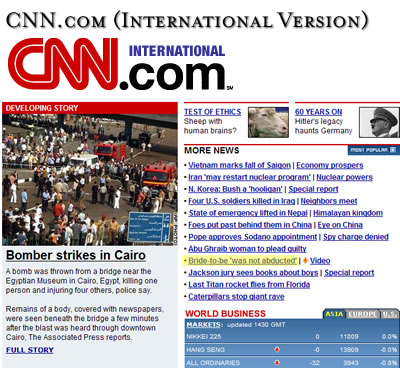
Case in point, here are CNN's two flagship sites right now (7:57 am, Pacific).


Source: CNN

Like its cable peer, CNN.com has gone completely apeshit. Iranian & North Korean nukes? Bombs exploding in Egypt? Don't bother me -- A bride faked her own abduction!


Source: CNN

This is CNN's international site (http://edition.cnn.com/). Look at this BBC-level of sophistication. They practically look like NPR. I've highlighted the same runner-bride story so you don't miss it. That's about the level of emphasis that the story deserves in America as well.

They can report important news first, they just choose not to. The entities that own these news outlets believe that they must maintain a tabloid angle in order to keep an audience for their advertisers. This strategy works for today...

...but tomorrow is an open question. There is a vacuum today for mass market, serious journalism -- a vacuum that (quite oddly) is being filled by a number of blogs.

Here are some recent viewership numbers concerning cable news popularity, taken directly from that Republican Flack, Matt Drudge. The number next to the show's name reflects 24-hour viewership in millions.
CABLE NEWS RACE
WED, JAN 05, 2005

FOXNEWS O'REILLY 2.3 [RATING]
FOXNEWS HANNITY/COLMES 1.7
FOXNEWS SHEP SMITH 1.6
FOXNEWS GRETA 1.4
CNN LARRY KING 1.1
COMEDY DAILY SHOW 1.1
CNN WAVE SPECIAL 0.8
MSNBC HARDBALL 0.5
MSNBC AMBER FREY 0.6
MSNBC SCARBOROUGH 0.4
MSNBC OLBERMANN 0.3
CNBC MILLER 0.1
Now take a look at the number of people who visit one of the more popular progressive blogs, Daily Kos. That's right, more people read Daily Kos than watch Chris Matthew's Hardball yellfest.

If major US news outlets fail to deliver intelligent news and commentary, their audience will learn to find it elsewhere.