Showing posts with label language. Show all posts

Thursday, July 03, 2008

Personally, I Prefer "S/H/It" or "S/H/Its"

Much as I dislike Facebook's use of the singular they throughout the site, today's change to its mini-feed is bound to aggravate someone.

Facebook has a tough time with the basics of language. Last year, it caved into user demands to remove "is" from its status message template, permitting a user to have a status outside the third-person singular present tense. Daring!

Saturday, May 03, 2008

Unconscience Error

I don't read many articles on car racing, but I like it when they contain wonderful malapropisms. Here's a bit from an ESPN article on Indycar's attempt to woo Dale Earnhardt, Jr. into the driver's seat for one of their races:
If Earnhardt's conscious wouldn't let him accept the contract, but his conscience would still permit it, then I suppose Mr. Gossage should only negotiate with his counterparty when the latter is unconscious or subject to subconscious influence.

Saturday, November 10, 2007

Smarty Pants

This cool gizmo lets you know what level of education is required to understand a given blog.

Thursday, October 11, 2007

Common Eponyms

An eponym is a word that was once a person's name but has come to have a broader meaning. Most eponyms are obvious — even if you don't know anything about the eponymous individuals, it's still clear that phrases like Benedict Arnold or Ponzi scheme or Achilles' tendon reference individuals (whether real or fictitious).

These proper eponyms don't interest me very much. I do enjoy, however, eponyms where the person's name has become such an utterly common word or phrase that the users of that word or phrase are completely unaware that it was formerly a person's name. I suppose the most typical examples of this kind of common eponym are sandwich (from the Earl of Sandwich) or teddy bear (from Teddy Roosevelt).

In the cumbersome paragraph below, each linked word is an eponym of this common sort:

Somehow, the diesel derrick's silhouette reminded the sideburn-wearing chauvinist of the daguerreotype of a mausoleum he had seen back when he was a mere guppy. "Bloomers or leotards?" his mentor asked. "Neither," the guy said. "I'm boycotting them. I'd rather be pierced by shrapnel, guillotined and lynched than to end up looking like a doily."
Link: Wikipedia List of Eponyms

Thursday, September 13, 2007

Arbitrator vs. Arbitrageur

It amuses me that two words with more-or-less the same etymology would have such different modern meanings:

When an arbitrageur sees bias and imbalance,
she seizes upon it for personal gain.

When an arbitrator sees bias and imbalance,
she tries to even the imbalance and undo the bias.

Monday, August 27, 2007

Útil Pero No Usa: El Gnaborretni

Following up on Andy’s post, I thought ’d highlight a related punctuation mark, the gnaborretni (the inverted interrobang, in more ways than one).

Sunday, August 26, 2007

Useful but Unused: The Interrobang

During the various Google searches I conducted for my post Janus Words & Contronyms, I stumbled across the interrobang, a logical little punctuation mark that absolutely no one uses.

What's the interrobang?!

Well, if you asked that question with an interrobang, it would look like this:

What's the interrobang‽

Yep. It's a combination of a question mark and an exclamation point, permitting you to ask an exasperated question without repeating ?!?!?! ad nauseum.

Invented in the 1960's by the head of an advertising agency, the interrobang never caught on. At this point, I wish the interrobang would catch on, as (1) it's a succinct expression of a clearly felt idea and (2) it eliminates those multiple punctuation marks that highlight the casual nature of today's near stream-of-consciousness email writing.

If you want to enhance your reputation as an eccentric among your friends, you can include the interrobang in your Microsoft Word documents by selecting it from the Wingdings 2 tray upon selecting Insert > Symbol from the primary menu.

Monday, August 20, 2007

Janus Words & Contronyms

It is with great hesitation that I write a post on language, for although I enjoy the occasional lay-audience book on language, I know almost nothing about linguistics or the formal study of language.

That said, I can't stop thinking about the word sanction.

In one context, sanction can mean to punish for disobedience: "Prior to the current war, the United States sanctioned Iraq." Conversely, sanction can mean approve and support: "The United States sanctions the actions of the current Iraqi regime." At least to this reader, these meanings appear to be almost polar opposites.

I'm not the only one who has noted this strange phenomenon. There are nearly a dozen terms for a word that has two opposite or contradictory meanings. My favorites are Janus words – Janus being the two-faced Roman god of beginnings and endings – and contronyms (though, in full disclosure, the latter term is championed by a judge on the Second Circuit, a court to which I have a particular attachment).

An in-depth description of the history and sociopsychological causes of the contronym phenomenon is beyond my abilities (although others have gone down this path) and the ambit of this blog; however, I can provide you with a few of my favorite contronyms (in no particular order):

  • sanction
    (see above)

  • (to) go off
    His cooking filled the kitchen with so much smoke, the fire alarm went off.
    vs.
    After its batteries ran out, the fire alarm went off.

  • quantum
    All of her research was conducted at the impossibly small quantum scale.
    vs.
    Newton's immense contribution to the body of knowledge represented a quantum leap forward.

  • custom
    Certain elements of their behavior were predictable, as the group was merely following custom.
    vs.
    His pants were so unique, they must have been custom-made.

  • moot
    They were all able to understand the problem better after they'd mooted it amongst themselves.
    vs.
    The point was moot and didn't even merit discussion.

  • scan
    He didn't get the article's deeper meaning, as he had only scanned it.
    vs.
    She had a detailed view of the image, as she had used a machine to scan it.
(For a longer list of contronyms, see here and here.)

Sunday, December 17, 2006

Just in Time for Finals: Word Shoot

You know finals are here when tempting eat-up-your-time-in-big-bites web-based video games just reveal themselves to you.

Enter Word Shoot, a flash-based game where you protect yourself from your relentless opponents by spelling their names. Text entry hasn't been this fear-based since Giraffe, the falling letter game that ships with Palm PDAs.

Tuesday, December 05, 2006

[Ch/H]a[n/nn]u[k/kk][a/ah]

Sometime reader of this blog and fellow Columbia Law student CSK has conducted a bit of a holiday investigation:

Andy,

As we approach the holiday season, I thought I'd investigate the various spelling of the Jewish holiday. I have found four common binary variations: Ch/H, n/nn, k/kk, and a/ah. The following is a list of the sixteen permutations, in order of the number of results from a Google search of each permutation.

Perhaps readers of your blog would appreciate this analysis?

Hanukkah — 12,100,000
Chanukah — 3,400,000
Hanukah — 1,010,000
Hannukah — 790,000
Chanuka — 545,000
Hanuka — 518,000
Channukah — 437,000
Chanukkah — 315,000
Chanukka — 301,000
Hanukka — 107,000
Hannuka — 62,500
Hannukkah — 44,200
Channuka — 18,800
Channukka — 1,750
Hannukka — 821
Channukkah — 741

Note that Microsoft Word reports that all but the top three spellings are incorrect.

CSK
I suspect that the inclusion of all these terms on my blog will change the context-sensitive Google Ads on this page through the end of the year.

Update (12/06/06): CSK's roommate ASL weighs in:
Working hard, aren't you?

The two variables about which I feel most strongly are the doubled consonants. The correct answer: one N, two K's. In proper Hebrew pronunciation, the kaf is doubled because it contains a dagesh chazak. In other words, the word would be broken into syllables as ha-nuk-kah rather than ha-nu-kah. (Several other Hebrew loan words are spelled with doubled consonants for the same reason - e.g. sabbath, hallelujah.) Granted, since most people don't pronounce dagesh chazak properly any more, I suppose it's reasonable to write only one K. The thing that's definitely wrong, though, is two N's. I'd guess that those spellings come largely as a result of people remembering that there's a doubled consonant but getting the wrong one.

As to the H vs. CH, question, obviously H with a dot underneath is the most ideal option, but that's hard to do on most word processors. I tend to use H here, but I admit that I sometimes use CH for het in some other contexts. If there's no option of having a dot, I'd say the CH is the best bet. Another spelling that occurs 1,290 times on Google is Khanuka (and variants), but I think it would be better to reserve KH for khaf and CH or H-dot (or h-bar!) for het. That distinction has been lost in Ashkenazi and modern Israeli Hebrew, but I'm pretentious that way. Another neat option is what Bryan/Aviel and other Sephardim do: Januk(k)a(h) (along with Pesaj).

As to the final H, it seems at first glance that the Hebrew spelling (with a hei) would mandate the H. However, a deeper analysis of Hebrew linguistics actually offers a rather compelling argument not to include the H. The details are too complicated to explain here, though.

Tuesday, October 17, 2006

The Holy Tango Anthology of Literature

In the Holy Tango Anthology of Literature, Francis Heaney explores the important question of "what would happen if poets and playwrights wrote works whose titles were anagrams of their names."

Some choice bits:

I WILL ALARM ISLAMIC OWLS
WILLIAM CARLOS WILLIAMS

I will be alarming
the Islamic owls
that are in
the barn

and which
you warned me
are very jittery
and susceptible to loud noises

Forgive me
they see so well in the dark
so feathery
and so dedicated to Allah


nice smug me
e. e. cummings

this here verse’s
disjunct
     i used to
     stick to regular metered
               poetry
now i write onetwothreefourfive poemsjustlikethat
                    Jesus

but this is simple work
            and what i want to know is
how much am i going to get paid for this
mister editor

Thanks, Jon!

Sunday, April 23, 2006

For Every Pig, There Will Be a Saturday

Like my friend Adam, I'm proud of the showing my alma mater made in the face of a Bush visit on short notice. On his blog, Adam pulls a choice quote from the Stanford Daily:

Some students, like incoming freshman Alejandra Aponte, said they were surprised by the protest’s high turnout.

“I thought Stanford was really a bubble, but seeing all the people that are out here has shown me that people really are concerned,” she said. “I’m Latina; I’m from Guatemala. Right now President Bush is doing some very interesting things in Latin America. We have a phrase ‘For every pig, there will be a Saturday.’ Basically, his game is over.” (Emphasis mine)
I'm sorry, dedicated vegans and fervent (Is there any other kind?) animal rights folks, but for every pig, there will be a Saturday is an apt description for a President who just polled at 33% approval at his pet Fox News.

If it ain't Saturday yet, then it's at least beer thirty on a Friday.

Tuesday, February 21, 2006

When the Going Gets Tough, the Tough Augment the English Language

What does George Bush do when he feels like no one agrees with him — y'know, like when he is party to a state-owned UAE venture taking over port operations at 6 Eastern seaboard ports?

He coins a new phrase. In this case, he's invented the phrase Great British.

Monday, February 13, 2006

K.I.S.S.

The message here? Just say lust.

Wednesday, February 08, 2006

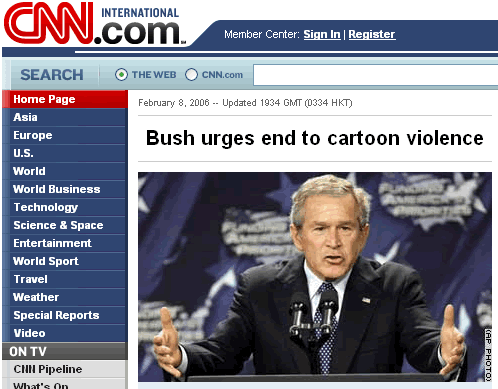
This Was the Best Headline They Had?

For the record, the President is also opposed to Melodramatic Sappiness, Overly Dry Wit, and 1980's-style Action Movie Arbitrary Nudity.

Wednesday, January 18, 2006

Say Wha? And You Thought US Legal Language Was Bad

Grammatically, judicial opinions delivered by the Cour de Cassation (French Supreme Court) consist of a single run-on sentence.

Saturday, December 17, 2005

Finals Procrastination, Part III: Ladle Rat Rotten Hut — Disgracing Is Verse

  1. Plug in headphones or turn on computer speakers.
  2. Click here. (Realplayer link)
  3. Click here to read what you just listened to.

Wednesday, October 12, 2005

You Say Tomato, I Say Suspicious

To CNN, Syria's foreign minister commits suicide. To the BBC, he "commits suicide."

Thursday, August 18, 2005

What 3 Days of Law School Have Taught Me

I promise that this blog will not become a blow-by-blow of law school, but I feel obligated to share my Deep Legal Insights™, having sat through a total of 8 law school classes so far.

My Tale of Law School Learning
Week 1

  • DO NOT be a worker who is injured on the job in early 19th century England.
  • DO expect that your boiler, car, coach, or gun will probably explode.
  • When an idea is too unclear to express in English, use Latin. That'll clear things right up.
  • DO NOT swim across the Harlem River from Manhattan to the Bronx, then frolic in the water below some power lines owned by a railroad. Nothing good can come from this.

Wednesday, July 27, 2005

It's Due to the Kinds of People Who Like Encyclopedias

Sometimes I just love how Wikipedians end up addressing topics in such a disinterested, unaffiliated, and ultimately even-handed way.