Showing posts with label constitution. Show all posts

Sunday, July 22, 2012

Individual Right to Bear 1791 Arms

In the shadow of the horrible, yet not shocking, tragedy in Aurora, Colorado, I keep thinking back to my proposal on the topic back in November 2007.

So long as SCOTUS is going to find that the Second Amendment is an individual right to bear arms (not a reaffirmation of the militia right), my view remains that the most workable solution for the demands of our modern society is some rather extreme originalism and federalism — the Second Amendment should protect an individual right to bear as such arms existed at the time of the ratification.

Let the states choose if they want to have gun rights beyond this basic backstop.


November 27, 2007 Sauntering - The Right to Bear Ye Olde Arms

Wednesday, June 18, 2008

Unequal Amendments

All men may be created equal—but not all laws are.

Since the ratification of the U.S. Constitution in 1787–90, the venerable document has been amended 27 times, but from a legal point of view not all of these amendments are equally important. Some amendments, such as the First Amendment’s guarantee of free speech, come up again and again in judicial opinions and legal scholarship. Other amendments, such as setting January 20 as the date of presidential inaugurations (the Twentieth Amendment), have rarely come up in litigation or commentary.

Having just graduated from law school, we here at Sauntering decided to produce a visual representation of the vast differences in relative importance of the amendments. What follows is a picture of all amendments written out in a font size corresponding to the relative citation frequency in Supreme Court and federal appellate court opinions. (To get a larger version, click on the image.)

Bill of Rights (First 10 Amendments)


All 27 Amendments


Our Methodology

To get the number of citations of each amendment, we searched AltLaw for “First [Second, etc.] Amendment” and “1st [2nd, etc.] Amendment.” This strategy means that we missed citations to “Eighth and Fourteenth Amendments,” etc.

Furthermore, although AltLaw’s database contains all U.S. Supreme Court opinions back to 1791, it contains only those U.S. Court of Appeals opinions published since 1950. Therefore, we have attempted to account for this by adjusting the citation numbers for the post-1950 amendments.

To deemphasize the immense citation difference between the major and minor amendments, we made the font sizes proportional to the square roots of the citation numbers.

For those readers with more than a passing interest in this little project, feel free to check out our raw data [Google Doc].

A final note: Although I came up with the idea of representing the amendments with font sizes, Sauntering founder and co-blogger Andy did the heavy lifting to research the amendment frequencies and come up with the visual display. Kudos to Andy!

Monday, March 24, 2008

Volunteers

When it comes to the Iraq War, I try to have sympathy for the Bush Administration.

Conspiracy theories aside, the planners of Iraq War – even if they are today dashing away from claiming responsibility for their actions – did not hope for a bungled war. These planners wanted a war where the U.S. would achieve quick victory, a war where our national self-interest would be improved. (I'll turn it back to the conspiracy theorists regarding what that self-interest was: Cheaper oil? Permanent U.S. military bases in the Middle East? The removal of Saddam Hussein and his WMDs?)

I try to have sympathy for these war planners, but then Dick Cheney – who appears to be the central figure of the entire Iraq War effort – starts talking, and my ability to have this sympathy is destroyed.

The recent public display of heartlessness by Dick Cheney concerning the pain that the Iraq War has wrought in the U.S. (...to say nothing of the much greater pain it has heaped upon the Iraqi people) literally takes my breath away. In a pair of interviews over the past week, Cheney provides a shocking window into his psyche.

So?
Last week, Cheney remarked "So?" when confronted by an interviewer with a poll indicating the public's broad current opposition to the Iraq War. Cheney claimed that it was important to not "be blown off course by the fluctuations in the public opinion polls."

Of course, today's broad opposition to the Iraq War is hardly a "fluctuation." Polls on Iraq have indicated majority opposition against the war from late 2005 onward. A fluctuation? Maybe on a clock that is tracking time on a geologic scale.

Much as I hate this "So?" comment, our Constitution has set the bar for impeachment inadvisably high for people like Cheney. However strongly critics of the President and Vice President might argue for their impeachment, until Bush et al. do something that looks like "Treason, Bribery, or other high Crimes or Misdemeanors" in the eyes of today's Supreme Court, our best hope is to use the other machinery of the federal government to limit the executive branch's influence for the remainder of Bush's lame duck term.

In the end, I hate Cheney's "So?" attitude, but I understand where he's coming from. We elected them. Barring impeachment, we're stuck with them. Let's demand Congress exercise its power to limit their influence. Someone has to be the least popular Vice President ever, and Cheney appears content to play the role.

Yet, I was not compelled to write about "So?" It's Cheney's comment from today that compels me to write.

They Volunteered
Confronted in an interview with the fact that the U.S. has just passed the grim milestone of 4,000 Americans dead in the Iraq War, Cheney reminded his interviewer several times that these soldiers volunteered.

Reading the article, I'm simply awestruck by how jaw-droppingly heartless Cheney comes across. He rationalizes that whatever burden communities, spouses, relatives, friends, and children bear at the loss or injury of a family member, this burden is somehow greatly eased by the fact of our all-volunteer force.

This August, I will have been writing this blog for 5 years. Over the course of writing 800 or so blog posts during this time, I've tried to develop a tone that is less confrontational than when I started blogging. Writing in a manner that tries (and, of course, fails) to see issues in shades of gray has been a continual challenge, but it's worth it — especially in developing my ability to talk about issues with people with whom I strongly disagree.

Cheney's words erase these shades of gray: Vice President Cheney, you have said and felt a horrible thing. You (and those around you?) have created a rationalization that helps you sleep at night. You've shared this rationalization with us, and it is disgusting.

As with "So?", Cheney's words carry a kernel of truth. We have an all-volunteer army. The military interests of our nation are protected by volunteers in a way that they weren't at Antietam, at Cold Harbor, on Omaha Beach, or in the Ardennes.

And let's ignore that our military draws heavily on disadvantaged populations and minorities to fill its ranks. Let's grant Cheney that, yes, we have a "volunteer" force.

Being a conscript is not the same thing as being a volunteer; however, the military requires that ALL soldiers follow orders. When rank and file soldiers confront death, even certain death, they do so at the order of another. It doesn't matter whether they're a volunteer or a draftee. An ordered military presumes – it demands – that a soldier abandon a significant portion of his or her free will in the name of achieving an objective. They must trust the system and the objective.

Iraq is a failed objective, and our continued project in Iraq is driven as much by the well-understood theory of Irrational Escalation as it by an effort to achieve ever-shifting military and geopolitical objectives.

Our soldiers volunteered to join the military. And then they were asked to do the impossible in Iraq, all the while staying in theater longer than any other soldiers in US history. They have obeyed orders and fought bravely.

That they fight and die as volunteers should do nothing to help us sleep better at night.

Volunteers & Conscripts. Side By Side.

Monday, March 17, 2008

Where Should I Park My 4 Guys?

Here she comes in her palanquin
on the back of an elephant
on a bed made of linen and sequins and silk...

The Infanta by The Decemberists
I'm a big fan of the Decemberists, but I sometimes suspect that frontman Colin Meloy pens his songs with one hand on a piano, the other on a thesaurus. Her palanquin? What the heck is a palanquin?

It's pretty clear from the context of the rest of the verse that a palanquin is something like an elaborate saddle for riding atop an animal. Yet, the real magic of the internet is that you only wonder these things for a moment now — before you turn to Wikipedia and get the (collectively created) answer.

Yes, a palanquin can be a small cabin supported by one or more animals...

...however, it can also be such a cabin supported by one or more people, as you've certainly seen in movies.

There's something astonishingly servile about a palanquin (or litter or sedan chair, as these contraptions are also known) when carried by other people. In many/most cases, the people riding in the palanquin could just as easily be walking; however, the dictates of society mean that they get to ride, borne quite literally on the backs of the less socially favored.

This menial, servile past was brought closer to home for me when I learned that Ben Franklin, afflicted by the gout and unable to ride a horse to the Constitutional Convention, was carried to the convention in his sedan chair. Franklin was borne by four convicts, and their appearance is partially captured in the painting below:

Sunday, February 10, 2008

A Toast to the Constitution: Temperance, A Benevolent Creator/Brewmaster, Happiness & Avoiding the Gout

(Crossposted from the American Constitution Society :: Columbia Law School)

Here's the toast from the 222nd Annual Constitutional Law Mixer, held at Columbia Law School on February 4, 2008. As in years past, the event was jointly hosted by the local chapters of the American Constitution Society, the Federalist Society, and the Constitution Law faculty here at Columbia.

First, I want to thank ACS & FedSoc for inviting me to give a toast at the 222nd Annual Constitutional Law Mixer. It's an honor to be a part of a tradition that predates both interchangeable parts and modern plumbing.

As Chancellor Kent was known to say: "Our annual Con Law Mixer? Yeah, that's kind of a big deal."


Back in May of last year, I stumbled across Robert Harris's review of the Barbara Holland book The Joy of Drinking. In Harris's review, he noted Holland's research into the role alcohol played in the creation of the United States Constitution. Harris writes that:
[I]n 1787, two days before their work was done, the 55 delegates to the Constitutional Convention “adjourned to a tavern for some rest, and according to the bill they drank 54 bottles of Madeira, 60 bottles of claret, 8 of whiskey, 22 of port, 8 of hard cider and 7 bowls of punch so large that, it was said, ducks could swim around in them. Then they went back to work and finished founding the new Republic.” Note the 55 delegates and 54 bottles of Madeira. Which founder was slacking?
PG, a recent CLS graduate and the only person I know whose Constitutional leanings led her to be an active member of both ACS and the Federalist Society, speculated that Thomas Mifflin – at the time the sitting President of Pennsylvania and a Quaker prior to his expulsion for serving in the Continental Army – was the teetotaler; however, given the amount of drink involved, it's unsurprising that the identity of the true abstainer would be lost to history.
Perhaps it was the drink, but there's so much about the Constitution that's been lost to history, so much that the Founders forgot to tell us about the meaning and the crafting of this founding document:
  • Dear Founders, is that a comma, a semi-colon, or a fleck of dirt?

  • O Breech-pants-wearing Founders, is the office of the Vice President firmly seated within the executive branch, or is it an extra-constitutional floater, like the extra outfielder in a game of slow-pitch softball?

  • O Founders, did you really believe that human nature would permit the loser of the Presidential election to serve as a good Vice-President to the winner?

  • Founders, why-oh-why did you decide to capitalize nearly every noun in the Constitution? ...and what's the deal with the handful you didn't capitalize? (...and 1L's: That's a gangbuster note topic, by the way.)

  • O Founders, are there secret messages in your tortured and inconsistent spellings?
Ultimately, we just don't know the answers to any of these vital questions, so we're left to make like the founders and drink a little Madeira, claret, whiskey, port and hard cider — maybe that will bring some clarity. (Incidentally, I was told that this event would have a bowl of punch so large that ducks could swim in it. Maybe that's coming later.)

In finishing my toast and finally raising a glass, I want to end with a meditation.

Let's meditate upon how the Constitution would have looked if Ben Franklin had had more creative control over the text. After all, historians report that when Thomas Jefferson sent Franklin a draft of the Declaration of Independence containing the line "We hold these truths to be sacred and undeniable," Franklin returned it to him with the last three words crossed out and replaced by "self-evident." Surely the person responsible for this memorable and meaningful term into the Declaration of Independence could have helped us more with the Constitution. (By the way, for those of you who are measuring the productivity of your lives against the lives of the Founders or choosing your political candidates on the basis of age, please note that Thomas Jefferson was all of 33 years old when he helped draft the Declaration of Independence.)

Now, I happen to know what Franklin would have done if he'd had his way with our overly short & oft-confusing Constitution. He would have included two final clauses.

In fact, I know which clauses Franklin would have inserted.

Truth be told, I find the tension between these two clauses to be roughly analogous to the on-going dialogue that occurs between the Federalist Society & ACS.

The first clause is a quote of Franklin's, taken from Poor Richard's Almanack, 1734. To me, this is the Federalist Society clause: "Be temperate in wine, in eating, girls, and sloth, or the gout will seize you and plague you both."

The second clause does not appear in any published writing of Franklin's, but has been broadly attributed to him. Naturally, the lack of textual basis for this quote (and its feel-good character) makes it more appropriate for ACS. The clause is: "Beer is proof that God loves us and wants us to be happy."

So please join me in raising a glass: Here's to Franklin, to the other Founders, to their strange and wondrous Constitution, to ACS, to the Federalist Society, to being happy, and – above all – to trying our best to avoid the gout.

CHEERS!

Tuesday, November 27, 2007

The Right to Bear Ye Olde Arms

(Crossposted from American Constitution Society :: Columbia Law School)

The ACS/Federalist Society sponsored discussion/debate on DC v. Heller – the first SCOTUS case since 1939 to address the meaning of the Second Amendment – won't begin for another 2 hours, but I am prepared to upstage the speakers by offering a workable solution for Second Amendment jurisprudence in the 21st Century.

Although the language of this amendment provides infinite grist for the mill of constitutional interpretation, my solution focuses exclusively on one word: arms.

My proposal: The Second Amendment protects an individual right to bear arms as such arms existed at the ratification.

Arms in 1791

Let's look at arms – specifically, guns – as they existed at the time of the ratification.

Guns in 1791 WOULD
Guns in 1791 WOULD NOT
Courts can't wish the Second Amendment away, but they can construe it in a manner that works in today's society.

Arthur Goldberg, the little-remembered Supreme Court Justice who sat on the bench from 1962 to 1965, has been long-derided by social and political conservatives as something of a fool due to his concurrence in Griswold v. Connecticut, where he found a right to privacy in the Ninth Amendment. Lately, these same conservatives have been quoting and paraphrasing Justice Goldberg when they say things like "while the Constitution protects against invasions of individual rights, it is not a suicide pact," a line Justice Goldberg included in Kennedy v. Mendoza-Martinez, 372 U.S. 144, 159-60 (1963). Applying an admittedly severe form of originalism to cabin the Second Amendment prevents the kind of suicide pact that Goldberg was worried about.

Michelle Obama created a bit of a stir earlier this week when she talked about how the need for guns might vary regionally within the United States. A backstop interpretation of the Second Amendment – one that only protects the individual right to bear arms as they stood in 1791 – permits states to develop right to bear arms appropriate to their circumstances.

Wednesday, August 29, 2007

2008 GOP Candidates: U.S. Founded as Christian Nation.

1797 Congress: No It Wasn't.

(Crossposted from the American Constitution Society :: Columbia Law School)

In Conroy v. Aniskoff, 507 U.S. 511, 520 (1993), Antonin Scalia includes a comment that he repeated here at Columbia Law School in 2006 — that the use of legislative history to bolster one's own position is "the equivalent of entering a crowded cocktail party and looking over the heads of the guests for one's friends." As much as I agree with Scalia here, I find it heartening to stumble across this bit of congressionally approved language from the 5th Congress:

Treaty of Peace and Friendship, signed at Tripoli November 4, 1796 (3 Ramada I, A. H. 1211), and at Algiers January 3, 1797 (4 Rajab, A. H. 1211). Original in Arabic. Submitted to the Senate May 29, 1797. (Message of May 26, 1797.) Resolution of advice and consent June 7, 1797. Ratified by the United States June 10, 1797. As to the ratification generally, see the notes. Proclaimed Jane 10, 1797.

ARTICLE 11

As the government of the United States of America is not in any sense founded on the Christian Religion,-as it has in itself no character of enmity against the laws, religion or tranquility of Musselmen,-and as the said States never have entered into any war or act of hostility against any Mehomitan nation, it is declared by the parties that no pretext arising from religious opinions shall ever produce an interruption of the harmony existing between the two countries.

Sunday, June 24, 2007

Drama Chipmunks/Prairie Dogs & the DMCA

This summary is not available. Please click here to view the post.

Monday, April 16, 2007

2nd Amendment Basis or Objective Basis for Firearm Ownership?

(Crossposted from the American Constitution Society :: Columbia Law School)

Although I do not agree with people who find a right to privately own firearms in the 2nd Amendment to the Constitution, I see their point. This amendment — along with a Congressional Commerce Power limited only by prudence and a 9th Amendment that either does nothing or everything — represents some of the most ambiguous, sloppy drafting in the entire Constitution. Although I don't think you have the constitutional right to buy one gun per month (a limit Virginia has placed on individual gun ownership), I see how people can seize upon the 2nd Amendment's sloppy drafting to claim that they do have such a right.

On the other hand, the people whom I do not understand are those people who ignore the historical accident of the 2nd Amendment and attempt to argue from first principles that a universally armed society is preferable to a less-than-fully-armed one.

When Kathryn Lopez, conservative blogger at The Corner on National Review Online, says:

If you want domestic tranquillity, an armed and responsible citizenry ready and able to protect life and property is not a bad way to start.
...she is calling for a type of Wild West society that has been rejected by the rest of the developed world.

Argue from the Constitution that you have a 2nd Amendment right to private gun ownership and I'll begrudgingly admit that you have a textual leg to stand on. Argue from first principles that the best society is one where we're all armed and I'll remind you that you stand in sharp disagreement with the rest of the developed world.

Update (4/19): My brother-in-law & sister-in-law (...once removed? What do you call the person who married your brother-in-law?) are living in France for several months, and here's Ilia's take on the tragedy at Virginia Tech.

The most telling passage:
In reading the French newspapers concerning the tragedy I noticed that they kept using the English terms "mass murder" and "school shootings" in lieu of using a similar phrase in French. Is it that they simply don't have the words for such atrocities, or are they so common in the US as to be better known around the world by their English names?

Wednesday, January 24, 2007

A Toast to the American Constitution Society, the Federalist Society, and the Agreed-upon Constitution

(Crossposted from the American Constitution Society :: Columbia Law School)

By popular demand, here's the toast from the Columbia Law School's ConLaw Mixer, held on January 23, 2007. The event was jointly hosted by the local chapters of the American Constitution Society, the Federalist Society, and the Constitution Law faculty here at Columbia.

When ACS President Jon Sherman asked me to say a few words for this event, I initially thought I’d focus on the differences in how the American Constitution Society and the Federalist Society approach the Constitution.

I mean, every ACS member knows that the members of the Federalist Society look longingly at the days before pasteurization — that they fancy themselves as yeoman farmers on the New Jersey frontier where they dream of a world in which interchangeable parts will someday be a reality.

Similarly, every FedSoc member knows that when the members of the American Constitution Society hear someone talking about "penumbras formed by emanations," they promptly instruct the bartender that they’ll have what that guy’s having.

. . . but these differences are minor. Today, let’s celebrate the similarities — of which there are many. I’ve spent the past couple days pouring over this document, locating areas of significant agreement. I’ve found three areas of broad agreement about the Constitution. Interpretations upon which we can all agree, areas that we can all toast.


AREA #1: We agree on many of the powers assigned either to the states or the various branches of our federal government.

What does this mean?

For the States, we shall not rest until states stop granting Letters of Marque and Reprisal and until they stop granting Titles of Nobility. We insist they settle their past debts using gold or silver.

For the Congress, we demand that it not shirk its duty to establish post Roads, to erect needful Buildings in D.C., and — as stated in Article 1, Section 5, clause 2 and reiterated the 20th Amendment — that it meet at least once every year.

For the Judiciary, we insist it remain vigilant to the needs of justice, that it insure no Attainder of Treason work Corruption of Blood, and that no one shall not be convicted of Treason without a rigorous trial consisting of at least 2 witness presenting evidence against her.

Most importantly, we ask that the judiciary fully enforce the 11th Amendment, whether that amendment actually means what it says . . . or whether actually every word of that amendment means the exact opposite of what it appears to mean.

Finally, concerning scope and appropriate exercise of Executive power, we… you know what, let’s just move on to Area #2.


AREA #2: I know I speak for everyone in this room when I say we supports the passage of the original 1st Amendment — the Congressional Apportionment Amendment.


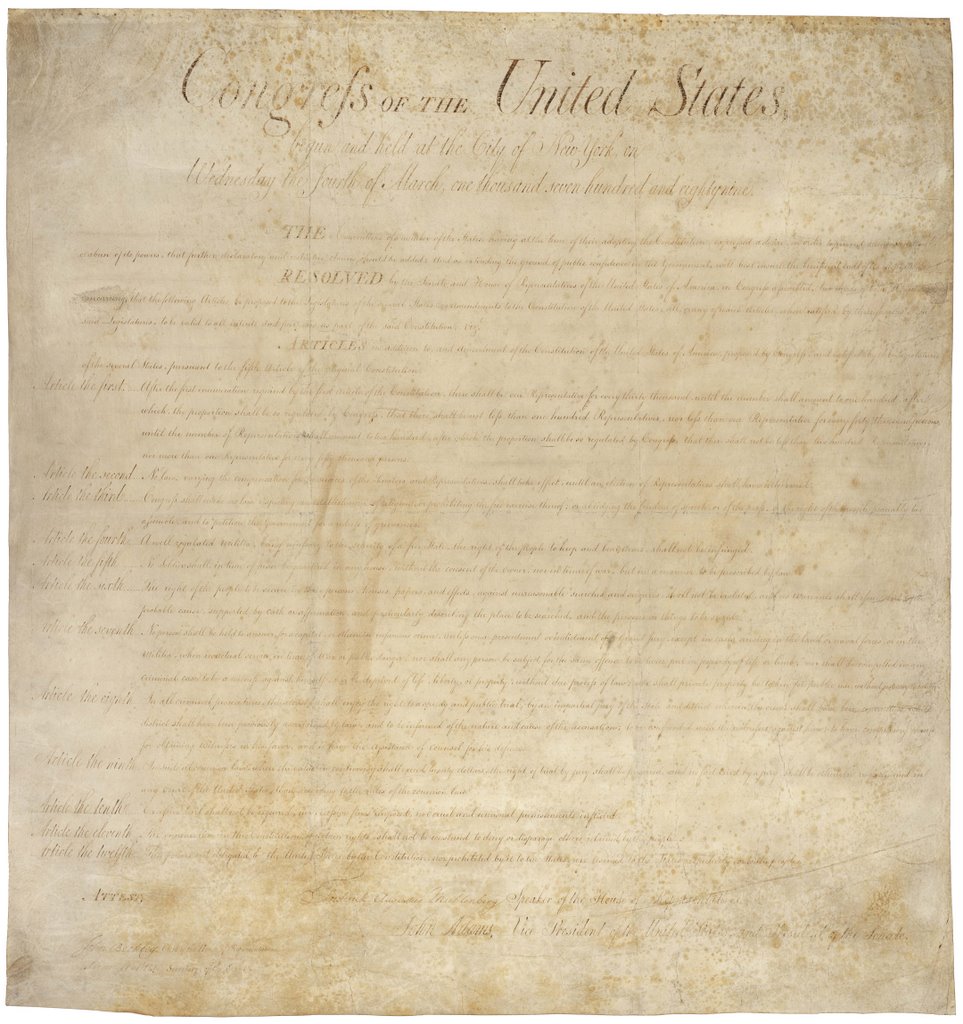
As many of you know, on September 25, 1789 the 1st Congress introduced 12 — not 10 — amendments to the states as the Bill of Rights.

The original 2nd Amendment — barring Congress from granting itself immediately effective pay raises — became the 27th Amendment on May 20, 1992. However, the original 1st Amendment was only ratified by 11 states — 2 shy of passage at the time. Since Coleman v. Miller makes clear that all amendments are considered pending before the state indefinitely unless Congress establishes a deadline within which the states must act, only 27 states are now needed to ratify this amendment for its passage. Hey 27 states, pass the original 1st Amendment.

If passed, the Congressional Apportionment Amendment would establish guidelines for the size of the House of Representatives. The Amendment’s math is a little hazy, but it ends with this important instruction: "there shall not be . . . more than one Representative for every 50,000 persons."

With a present US population of more than 300 million people, this introduces the possibility of a 6,000-member House of Representatives. I know I speak for everyone here when I say that if there’s one thing that the august body of the House needs to be truly effective, it’s to have 5,565 members added to its ranks.


In closing, Area #3 is really a pledge:

AREA #3: We pledge from this day forth that we shall write like the authors of our Constitution.

Not only shall we employ capitalization seemingly at random and use either British, tortured, or inconsistent spelling whenever possible, but — like the Constitution’s signatories — we shall sign our name to documents using absurd abbreviations.

I mean, why grace the document with your full name — it’s only a Constitution? These people, these founders, signed the Constitution with all the formality of someone signing a traffic ticket. William Blount went with the predictable "Wm." but William Livingston chose the path of a hipster, abbreviating "Wil:" Jonathan Dayton became "Jona:" Robert Morris became "Robt." . . . and anyone who has studied with Professor Hamburger will know who I’m talking about when I tell you that one of them merely signed "Gouv."

5 of the signatories determined that their signatures constituted little micro-sentences, worthy of ending with a period. We, too, shall end our signatures with periods. From this day forward, if you see a document signed "And: Brad:." know that it is me.


As you can see folks, our points of agreement are broad and substantial. So here’s to our agreements and our differences, here’s to our faculty and our constitutional societies, and here’s to the wig-and-tight-pants-wearing founders who made it all possible. Cheers!

Tuesday, December 05, 2006

When It Says Religious Test, It Doesn't Mean Test Like the S.A.T.

(Crossposted from the American Constitution Society :: Columbia Law School)

The American Family Association – worried that newly-elected Representative Keith Ellison (D-MN), who happens to be Muslim, will be sworn in with his hand on the Koran (instead of the Christian Bible) – is urging its members to do the following:

  1. Send an email asking your U.S. Representative and Senators to pass a law making the Bible the book used in the swearing-in ceremony of Representatives and Senators.

  2. Forward this email to your friends and family today!
Never mind that Representatives don't place their hands on anything when they're sworn in en masse. How the AFA-proposed law wouldn't violate Article VI, Section 3 is beyond me:
The Senators and Representatives before mentioned, and the members of the several state legislatures, and all executive and judicial officers, both of the United States and of the several states, shall be bound by oath or affirmation, to support this Constitution; but no religious test shall ever be required as a qualification to any office or public trust under the United States. (emphasis added)
Too many more oversights like this and I'm going to stop turning to the American Family Association for my constitutional theory.

Thursday, November 23, 2006

If I Include "Second Amendment" in the Title of My Bill, Does that Make it a Proposed Amendment?

(Crossposted from the American Constitution Society :: Columbia Law School)

There are many reasons for Congress to consider legislation. One of the primary reasons for Congress to consider legislation is that it believes that the judiciary will not find the subject matter of the statute already protected by the Constitution.

Last Thursday, Lame Duck Virginia Senator George Allen proposed SB 4057, tentatively titled The National Park Second Amendment Restoration and Personal Protection Act of 2006. According to the current description of the bill, it would "protect the second amendment rights of individuals to carry firearms in units of the National Park System." If passed, it would permit a properly licensed individual to carry a concealed weapon in a National Park.

Of course, the bill's title and short description do nothing other than to obscure the bill's point and confuse debate. The Second Amendment doesn't grant you the right to carry a concealed weapon in the National Park System. That's why you're proposing this law.

Sunday, November 19, 2006

Failed Amendments We Have Known & Loved

(Crossposted from the American Constitution Society :: Columbia Law School)

Barring an unexpected Lame Duck attempt to amend the U.S. Constitution, Democratic control of Congress will probably result in a temporary moratorium on proposed amendments to the Constitution that would ban gay marriage or ban burning Old Glory.

Of course, the G.O.P. does not have a monopoly on converting a Congressional majority into failed attempts to amend the Constitution. During the next 2 years of their pending majority, if the Democrats need to find examples of entertaining failed attempts to amend the U.S. Constitution, history provides some real doozies.

In this post, we'll explore three prominent categories of failed Constitution amendments.

Zombie Amendments:
Approved, Not Ratified, No Expiration Deadline


Starting in the early 20th century, Congress began placing deadlines on the amendments it sent to the states for ratification. Typically, the states were given seven years to ratify an amendment. After the passage of the deadline, the proposed amendment would expire and Congress would need to start the process all over again to raise the issue. (In the past 50 years, two amendments expired after Congressional approval: the 1972 Equal Rights Amendment & the 1978 D.C. Voting Rights Amendment)

However, absent explicit sunset provisions, approved yet unratified amendments do not expire.1 Instead, they linger eternally, pending ratification. As shown with the 27th Amendment, an amendment which floated around for 200 years before finally being ratified in the 1990's, each of these amendments has the potential of becoming law.

Congressional Apportionment Amendment: This proposed amendment was the first of the original twelve amendments proposed to Congress (The original 2nd Amendment eventually became the 27th Amendment mentioned above). If passed, the amendment would have restricted the original size of the House of Representatives to 100 representatives, with later enlargements to be determined by Congress. From 1789 to 1792, 11 states ratified this amendment, leaving it two states short of ratification.

Titles of Nobility Amendment: Proposed in 1810, this amendment would strip U.S. citizenship from any citizen accepting, claiming, retaining, or receiving a foreign title of nobility without the consent of Congress.

Believed by some [See here and here. For a rebuttal, see here. (Apply salt liberally to the arguments on these web pages.)] to have been ratified and then supressed by a conspiracy of lawyers (who – so the theory goes – would lose their citizenship via their esquire title), this amendment was approved by 12 states, just one shy of full ratification. Since, at the time, it came within one house of the South Carolina legislature of being ratified, some 19th century printings of the Constitution erroneously include it as the 13th Amendment.2

Pro-Slavery Amendment: A last-ditch effort to avoid a civil war, this amendment – approved by the House and Senate on Februrary 28 & March 2, 1861, respectively – stated simply:
No amendment shall be made to the Constitution which will authorize or give to Congress the power to abolish or interfere, within any State, with the domestic institutions thereof, including that of persons held to labor or service by the laws of said State.
Apart from its subject matter, the language of this amendment raises an important issue in U.S. Constitutional theory: Can a Constitutional amendment prohibit a later amendment through an entrenched clause?

Although this amendment was ultimately ratified by Ohio and Maryland, neither legislature ratified it before the start of Civil War hostilities with the Battle of Fort Sumter on April 12, 1861.

Child Labor Amendment: Proposed in 1924 and ratified by 28 states, this still-pending amendment requires the approval of 10 more states in order to restrict to the federal government all power to regulate labor of persons under 18 years old.

This amendment is a direct reaction to the Child Labor Tax Case,3 which found Congress had overstepped the boundaries of the 10th Amendment with the scope of the taxes it placed on factories employing child labor.

Let's Remake America Amendments:
Ambitious Attempts to Change this Country

Had they been ratified, these proposed amendments would dramatically change the way our country works.No Way, José Amendments:
That's Just Crazy Talk

These proposed amendments were going exactly nowhere, but that's why we like 'em.

1 Coleman v. Miller, 307 U.S. 433, 454 (1939) (Finding that all amendments are considered pending before the states indefinitely unless Congress establishes a deadline within which the states must act.)

2 In Campion v. Towns, 2005 WL 2160115 at *1 (D. Ariz. 2005), a tax protester produced an 19th century archival copy of the Constitution incorrectly listing the Titles of Nobility Amendment as the 13th Amendment. Needless to say, the argument based on the existence of this document did not go very far with the Court.

3 Bailey v. Drexel Furniture Co., 259 U.S. 20 (1922)

4 354 U.S. 1 (1957)

Monday, July 24, 2006

The Third Amendment: The Little Amendment That Couldn't

(Crossposted from the American Constitution Society :: Columbia Law School)

Stop what you're doing.

If you're a law student or a lawyer, the odds are pretty good that you're within easy walking distance of a copy of the U.S.C.A. Go to this multi-volume juggernaut.

The first umpteen volumes of this leather-bound behemouth are devoted to the U.S. Constitution and its amendments. Grab the volume dedicated to the first four amendments.

As you likely know, the U.S.C.A. is an annotated version of the codified statutes of the United States. Adjacent to a statute, the publisher (West) has attempted to include influential cases that reference that statute. Flip to the Third Amendment.

While flipping, you may have noticed that the First Amendment has about 150 pages of one-paragraph case synopses that illustrate how, over time, courts have interpretted the protections laid out in the First Amendment's 45 words.

If you flipped too far, you may have noticed the Fourth Amendment has about 400 pages of material dedicated to the constitutional protection against various unreasonable searches and seizures.

How many pages are devoted to the Third Amendment?

2

The republic is in its 230th year, with a constitution that is 217 years old. ...and yet there are 2 pages worth of cases that say anything interesting about the Third Amendment. Let's take a tour:

First, the text:

No Soldier shall, in time of peace be quartered in any house, without the consent of the Owner, nor in time of war, but in a manner to be prescribed by law.
Cornell's Annotated Constitution claims:
There has been no Supreme Court explication of this Amendment, which was obviously one guarantee of the preference for the civilian over the military. In fact, save for the curious case of Engblom v. Carey, 677 F. 2d 957 (2d Cir. 1982), on remand, 572 F. Supp. 44 (S.D.N.Y.), aff’d. per curiam, 724 F.2d 28 (2d Cir. 1983), there has been no judicial explication at all.
Au contraire. No fewer than seven cases have mentioned this sacred protective amendment, at least three of which bear mentioning.

First, back in the day of penumbras, a footnote in Katz v. US notes that this amendment protected at least one "aspect of privacy from governmental intrusion."1

Next, although the common law Ad Coelum rule (the rule's full name translates roughly as "To whomever the soil belongs, he owns also to the sky and to the depths.") was put out of commission 65 years before by Hinman v. Pacific Air Transport and its sister cases, the Custer County Action Association still forwarded an Ad Coelum-related theory in its 2001 case.2 The association claimed that peacetime military overflights were a per se unconstitutional quartering of soldiers on their property.3 Needless to say, the 10th Circuit disagreed rather heartily.

Finally, the last case bearing mention is Engblom v. Carey, which (as the quote above notes) is probably the only lengthy judicial discussion of the Third Amendment.4 Although I agree with Engblom's core holding, that National Guardsmen are "soldiers" within the meaning of the Third Amendment, I must sheepishly disagree with one of Engblom's other holdings — that the Third Amendment applies to the states via incorporation in the Fourteenth Amendment.5

Notwithstanding Barron v. Baltimore,6 it appears to me that the Third Amendment applies directly to state militias (given the National Guard's formation via the Militia Act of 1903, I'm treating them as state militias for the purpose of this argument.)

Article I, Section 10, Clause 3 reads:
No State shall, without the Consent of Congress, lay any Duty of Tonnage, keep Troops, or Ships of War in time of Peace, enter into any Agreement or Compact with another State, or with a foreign Power, or engage in War, unless actually invaded, or in such imminent Danger as will not admit of delay. (emphasis added)
Since a state could not maintain soldiers other than with the approval of Congress, since the Third Amendment says "No Soldier," not "no federal soldier," and since the Third Amendment provides a logical backstop to the militia power defined in the Second Amendment, it appears to me that the Third Amendment would have logically applied to the states before the Fourteenth Amendment made it so.


1 Katz v. US, 389 U.S. 347, 351 n.5 (1967).

2 Hinman v. Pacific Air Transport, 84 F.2d 755 (9th Cir. 1936); cert. denied, 300 U.S. 654 (1937); see US v. Causby, 328 U.S. 256, 261 (1946) (acknowledging that while a Fifth Amendment remedy might exist if flights over private property directly and immediately interfere with the enjoyment and use of the land, Congress has declared "[t]he air is a public highway" and "[c]ommon sense revolts at the idea" that aircraft operators would be subject to trespass suits based on common law notions of property ownership extending to the periphery of the universe). Black's Law Dictionary (6th ed 1990).

3 Custer County Action Ass'n v. Garvey, 256 F.3d 1024, 1042-43 (10th Cir. 2001).

4 Engblom v. Carey, 677 F.2d 957 (2d Cir. 1982), on remand 572 F. Supp. 44 (S.D.N.Y. 1983).

5 Id. at 961-62.

6 Barron v. Baltimore, 32 U.S. 243 (1833) (determining that the Bill of Rights did not apply to state governments)

(Thanks to Colin for the U.S.C.A. tip)

ABA to Executive Branch: "The Constitution is not what the President says it is."

(Crossposted from the American Constitution Society :: Columbia Law School)

An ABA task force is urging Congress to pass legislation permitting court review of presidential signing statements.

Although the Justice Department claims that President Bush has only issued 110 signing statements (to Clinton's 80 such statements), the ABA task force cites research that Bush has challenged the constitutionality of 800 provisions of law passed by Congress.

Wednesday, May 17, 2006

I'm Glad I'm Not the Only One Who Finds Constitutional Law Challenging

(Crossposted from the American Constitution Society :: Columbia Law School)

The U.S. Citizenship and Immigration Services flashcards designed to help applicants study for US citizenship exam omit the freedom of the press.


The full(ish) set can be downloaded here (.pdf link).

Thursday, April 06, 2006

Way to Go, Harry Taylor

Colin points out that Harry Taylor, today's shining example of civic courage, evokes a classic American theme.

Monday, March 13, 2006

Illinois Senate Bill 2724: An Irrelevant Electoral College? (Part II)

(Crossposted from the American Constitution Society :: Columbia Law School)


(For Part I of this story and Andy's personal beef with the electoral college system, click here.)

Instead of personally characterizing Illinois Senate Bill 2724, I'll leave that task to Hendrik Hertzberg, who wrote about the bill for the New Yorker:

Here's how the plan would work. One by one, legislature by legislature, state law by state law, individual states would pledge themselves to an interstate compact under which they would agree to award their electoral votes to the nationwide winner of the popular vote. The compact would take effect only when enough states had joined it to elect a President — that is, enough to cast a majority of the five hundred and thirty-eight electoral votes. (Theoretically, as few as eleven states could do the trick.) And then, presto! All of a sudden, the people of all fifty states plus the District of Columbia are empowered to elect their President the same way they elect their governors, mayors, senators, and congressmen. We still have the Electoral College, with its colorful eighteenth-century rituals, but it can no longer do any damage. It becomes a tourist attraction, like the British monarchy.
The effort is called National Popular Election, and it has the support of The Center for Voting & Democracy, the leader in US election reform.

As the Per Curiam opinion in Bush v. Gore, 531 U.S. 98 (2000), notes, "the State legislature's power to select the manner for appointing electors is plenary; it may, if it so chooses, select the electors itself, which indeed was the manner used by State legislatures in several States for many years after the Framing of our Constitution." If this 6-year old statement even remotely reflects the current sentiment on SCOTUS, the National Popular Election effort would easily withstand constitutional scrutiny.

Here's hoping that enough states exercise this plenary power in such manner as to give voice to the will of the national electorate. The Illinois bill is currently in committee. Keep your fingers crossed. Your vote for the President may count soon enough.

Illinois Senate Bill 2724: An Irrelevant Electoral College? (Part I)

(Crossposted from the American Constitution Society :: Columbia Law School)

Each State shall appoint, in such Manner as the Legislature thereof may direct, a Number of Electors, equal to the whole Number of Senators and Representatives to which the State may be entitled in the Congress.
Article II § 1.2
Growing up the son of two Democrats in the blood red state of Nebraska, I quickly developed a disdain for our electoral college system. Since Nebraska's electoral college votes have gone to the Republican candidate in every presidential election since Nixon in 1968, my parents' Democratic votes have never actually contributed to a winning candidate's total (never, except for my father's inexplicable 1972 Nixon vote, a ballot that will forever live in family infamy).


High school civics course arguments in support of the oft-criticized electoral college system generally cite the need to prevent the more populous states from luring Presidential campaign attention entirely away from less peopled states. (A final Nebraska anecdote: No system can prevent a state from falling off the map of a sitting President. Having previously visited the other 49 states, Nebraska was the last state visited by Bill Clinton during his presidency. Even then, he had to be lured into the state through the erection of one of the nation's sillier museums.)

But does this argument hold water? Hendrik Hertzberg points out in the New Yorker that the Presidential game (if ever fought in the small states) has moved to the battleground "purple" states:
In 2004, there were thirteen such states, accounting for twenty-eight per cent of the population (and thirty-two per cent of the ultimate vote, since turnout increases with the uncertainty of the outcome). In the final month, the candidates spent $237 million on advertising, $229 million of it in those thirteen states. (In twenty-three states, they didn’t spend a dime.) At the same time, President Bush, Vice-President Cheney, Senator Kerry, and Senator Edwards attended a total of two hundred and ninety-one campaign events. Two hundred and sixty-eight of them were in the lucky thirteen.
Even if arguments in favor of maintaining the electoral college status quo are less than compelling, the strongest argument that the electoral college system is here to stay has always been the difficulty in changing our system of electors. Amending the US Constitution to enable the direct election of the President would require a 2/3rd vote of both houses of Congress and then ratification by "three fourths of the several States."

As power shifts from party to party, neither side could be relied on to provide support consistent enough to clear this high hurdle for reform. As the New Yorker article notes, Bush may have been a big fan of the electoral college in 2000, when he became the first person since Benjamin Harrison to win the Presidency and lose the popular vote; however, he probably held the electoral college in considerably less esteem in 2004, when despite his clear margin in the popular vote, he nearly lost to John Kerry but for 60,000 votes in Ohio.

Of course, all of the above is old news to you.

The new news is that a bill was introduced in the Illinois Senate on January 20th that could all but render the electoral college moot. The bill's chances of passage look strong, it appears constitutional, and it eliminates the electoral college's anti-democratic nature without requiring an amendment.

If Illinois Senate Bill 2724 is passed, and if companion bills pass in 10 other states (CA, TX, NY, FL, PA, OH, MI, GA, NJ, NC), then – without possibility of exception – the winner of the popular vote will be the winner of the presidential election.

(Read Part II of this story to learn about Illinois Senate Bill 2724)

Tuesday, January 24, 2006

The Fœderalist Papers

(Crossposted from Columbia Law School :: American Constitution Society)

In the Federalist Papers, published in 1788, federal is written fœderal.

As this spelling makes one go bug-eyed in a hurry, most current editions use the modern spelling.

Procrastinating? Here's Wikipedia's list of words that may be spelled with a ligature.