Showing posts with label SCOTUS. Show all posts

Sunday, July 22, 2012

Individual Right to Bear 1791 Arms

In the shadow of the horrible, yet not shocking, tragedy in Aurora, Colorado, I keep thinking back to my proposal on the topic back in November 2007.

So long as SCOTUS is going to find that the Second Amendment is an individual right to bear arms (not a reaffirmation of the militia right), my view remains that the most workable solution for the demands of our modern society is some rather extreme originalism and federalism — the Second Amendment should protect an individual right to bear as such arms existed at the time of the ratification.

Let the states choose if they want to have gun rights beyond this basic backstop.


November 27, 2007 Sauntering - The Right to Bear Ye Olde Arms

Tuesday, October 06, 2009

Awwwkward

I once had a boss who occasionally asked us to do things that we'd really rather not do. For example, he once asked my co-worker to fight a parking ticket for him.

I was reminded of this by a copyright case in which the Supreme Court will hear oral argument tomorrow, Reed Elsevier Inc., et al., v. Muchnik, et al. (08-103). As happens occasionally, the Court rejected the issues presented by the petition for certiorari and wrote its own instead. What is far more curious, however: all the parties are on the same side of the issue the Court decided to hear — they are all against the Second Circuit's ruling on it.

So the Court got Ohio State law professor Deborah Jones Merritt to argue that side. I can just imagine that phone call:

PROF. MERRITT: Hello?

C.J. ROBERTS: Howdy Professor, this is John Roberts!

PROF. MERRITT: The Chief Justice?

C.J. ROBERTS: That's the one.

PROF. MERRITT: Oh, um, ah, hello your Honor. How may I help you?

C.J. ROBERTS: Well, see, we've got this case. We're thinking about granting a writ of certiorari, but, I'll be honest, these guys kinda missed the boat with their petition.

PROF. MERRITT: I see . . . . I don't want to tell you how to do your job, but couldn't you just deny the petition?

C.J. ROBERTS: Welllll, yeeaaaah, I suppose. But the case implicates a pretty important question they didn't raise.

PROF. MERRITT: That makes sense. Well, you're the Supreme Court! You can write the question yourselves, right?

C.J. ROBERTS: Exactly! That's what I keep telling everybody.

PROF. MERRITT: So what's the problem?

C.J. ROBERTS: Well, don't tell anyone, but we kinda want to reverse the Second Circuit.

PROF. MERRITT: So?

C.J. ROBERTS: The problem is, all the parties want us to reverse the Second Circuit on our question, too.

PROF. MERRITT: Oh, that is tricky.

C.J. ROBERTS: So . . .

PROF. MERRITT: Yes?

C.J. ROBERTS: Wouldja mind arguing the other side?

Just like my co-worker, who dutifully fought our boss's parking ticket, Professor Merritt couldn't bring herself to say no.

Good luck tomorrow, Professor!

Friday, July 04, 2008

Some Heroic Moments for this Independence Day

At some point, our society began holding lawyers in low regard. This cultural contempt goes beyond despising the relatively more affluent or detesting ambulance chasers.

As I navigated my way through law school, it occurred to me that one of the primary sources of frustration against lawyers is our frustration with society itself. Our society – like any developed society – can be a morass of regulations and requirements, limitations that are (at least in theory) designed to protect us from ourselves and others. Since we can't lash out against this faceless system, we choose to vent our frustration at those who seem to guard the gates to this machine.

Although going to law school means choosing to become one of these social pariahs, most (many?) would say it was worth it. On this Independence Day, I want to celebrate a hidden benefit of law school. Although law school's tour of legal history reveals more than a few legal villains, it also uncovers a number of legal heroes.

Here are a couple lawyerly actions that I first learned about in law school and which make me proud to be an American today. The first is heroic for its effect, if not its intent. The latter, for both.


  1. President Dwight D. Eisenhower on September 8, 1953: Chief Justice Fred Vinson died on September 8, 1953, after the rehearing of Brown v. Board of Education had been reordered but not heard.

    Had Vinson survived to rule on Brown's rehearing, Justice Felix Frankfurter believed there would have been 4 dissenters. According to legal legend, Frankfurter remarked that Vinson's death was "the only evidence I have ever had for the existence of God," for it permitted the nomination of Earl Warren to replace him on the bench.

    At Vinson's death, Eisenhower kept a promise to then California governor Earl Warren to nominate him to the first available seat on the Supreme Court. With Warren at the helm, the Supreme Court unanimously ruled in Brown's rehearing that separate but equal facilities were unconstitutional.

    Though Eisenhower would go on to consider his nomination of Warren to be a mistake, Eisenhower's promise to Warren led to the creation of the Warren Court and the dramatic expansion of civil rights in the decades that followed.

  2. Senator Clair Engle on June 10, 1964: The Civil Rights Act of 1964 was filibustered in the Senate for 57 days and its passage looked uncertain.

    California Senator Engle, who had been struggling with brain cancer since 1963, returned to the Senate floor on June 10, 1964, to participate in the vote to end debate. Unable to speak due to his advanced cancer, Senator Engle pointed to his eye to indicate "aye" as his name was called in the roll-call vote. Engle's vote ultimately was one of the deciding votes, as cloture was met, ending the filibuster and permitting the Civil Rights Act of 1964 to become law.

    Clair Engle died one month later.

Sunday, February 10, 2008

A Toast to the Constitution: Temperance, A Benevolent Creator/Brewmaster, Happiness & Avoiding the Gout

(Crossposted from the American Constitution Society :: Columbia Law School)

Here's the toast from the 222nd Annual Constitutional Law Mixer, held at Columbia Law School on February 4, 2008. As in years past, the event was jointly hosted by the local chapters of the American Constitution Society, the Federalist Society, and the Constitution Law faculty here at Columbia.

First, I want to thank ACS & FedSoc for inviting me to give a toast at the 222nd Annual Constitutional Law Mixer. It's an honor to be a part of a tradition that predates both interchangeable parts and modern plumbing.

As Chancellor Kent was known to say: "Our annual Con Law Mixer? Yeah, that's kind of a big deal."


Back in May of last year, I stumbled across Robert Harris's review of the Barbara Holland book The Joy of Drinking. In Harris's review, he noted Holland's research into the role alcohol played in the creation of the United States Constitution. Harris writes that:
[I]n 1787, two days before their work was done, the 55 delegates to the Constitutional Convention “adjourned to a tavern for some rest, and according to the bill they drank 54 bottles of Madeira, 60 bottles of claret, 8 of whiskey, 22 of port, 8 of hard cider and 7 bowls of punch so large that, it was said, ducks could swim around in them. Then they went back to work and finished founding the new Republic.” Note the 55 delegates and 54 bottles of Madeira. Which founder was slacking?
PG, a recent CLS graduate and the only person I know whose Constitutional leanings led her to be an active member of both ACS and the Federalist Society, speculated that Thomas Mifflin – at the time the sitting President of Pennsylvania and a Quaker prior to his expulsion for serving in the Continental Army – was the teetotaler; however, given the amount of drink involved, it's unsurprising that the identity of the true abstainer would be lost to history.
Perhaps it was the drink, but there's so much about the Constitution that's been lost to history, so much that the Founders forgot to tell us about the meaning and the crafting of this founding document:
  • Dear Founders, is that a comma, a semi-colon, or a fleck of dirt?

  • O Breech-pants-wearing Founders, is the office of the Vice President firmly seated within the executive branch, or is it an extra-constitutional floater, like the extra outfielder in a game of slow-pitch softball?

  • O Founders, did you really believe that human nature would permit the loser of the Presidential election to serve as a good Vice-President to the winner?

  • Founders, why-oh-why did you decide to capitalize nearly every noun in the Constitution? ...and what's the deal with the handful you didn't capitalize? (...and 1L's: That's a gangbuster note topic, by the way.)

  • O Founders, are there secret messages in your tortured and inconsistent spellings?
Ultimately, we just don't know the answers to any of these vital questions, so we're left to make like the founders and drink a little Madeira, claret, whiskey, port and hard cider — maybe that will bring some clarity. (Incidentally, I was told that this event would have a bowl of punch so large that ducks could swim in it. Maybe that's coming later.)

In finishing my toast and finally raising a glass, I want to end with a meditation.

Let's meditate upon how the Constitution would have looked if Ben Franklin had had more creative control over the text. After all, historians report that when Thomas Jefferson sent Franklin a draft of the Declaration of Independence containing the line "We hold these truths to be sacred and undeniable," Franklin returned it to him with the last three words crossed out and replaced by "self-evident." Surely the person responsible for this memorable and meaningful term into the Declaration of Independence could have helped us more with the Constitution. (By the way, for those of you who are measuring the productivity of your lives against the lives of the Founders or choosing your political candidates on the basis of age, please note that Thomas Jefferson was all of 33 years old when he helped draft the Declaration of Independence.)

Now, I happen to know what Franklin would have done if he'd had his way with our overly short & oft-confusing Constitution. He would have included two final clauses.

In fact, I know which clauses Franklin would have inserted.

Truth be told, I find the tension between these two clauses to be roughly analogous to the on-going dialogue that occurs between the Federalist Society & ACS.

The first clause is a quote of Franklin's, taken from Poor Richard's Almanack, 1734. To me, this is the Federalist Society clause: "Be temperate in wine, in eating, girls, and sloth, or the gout will seize you and plague you both."

The second clause does not appear in any published writing of Franklin's, but has been broadly attributed to him. Naturally, the lack of textual basis for this quote (and its feel-good character) makes it more appropriate for ACS. The clause is: "Beer is proof that God loves us and wants us to be happy."

So please join me in raising a glass: Here's to Franklin, to the other Founders, to their strange and wondrous Constitution, to ACS, to the Federalist Society, to being happy, and – above all – to trying our best to avoid the gout.

CHEERS!

Tuesday, November 27, 2007

The Right to Bear Ye Olde Arms

(Crossposted from American Constitution Society :: Columbia Law School)

The ACS/Federalist Society sponsored discussion/debate on DC v. Heller – the first SCOTUS case since 1939 to address the meaning of the Second Amendment – won't begin for another 2 hours, but I am prepared to upstage the speakers by offering a workable solution for Second Amendment jurisprudence in the 21st Century.

Although the language of this amendment provides infinite grist for the mill of constitutional interpretation, my solution focuses exclusively on one word: arms.

My proposal: The Second Amendment protects an individual right to bear arms as such arms existed at the ratification.

Arms in 1791

Let's look at arms – specifically, guns – as they existed at the time of the ratification.

Guns in 1791 WOULD
Guns in 1791 WOULD NOT
Courts can't wish the Second Amendment away, but they can construe it in a manner that works in today's society.

Arthur Goldberg, the little-remembered Supreme Court Justice who sat on the bench from 1962 to 1965, has been long-derided by social and political conservatives as something of a fool due to his concurrence in Griswold v. Connecticut, where he found a right to privacy in the Ninth Amendment. Lately, these same conservatives have been quoting and paraphrasing Justice Goldberg when they say things like "while the Constitution protects against invasions of individual rights, it is not a suicide pact," a line Justice Goldberg included in Kennedy v. Mendoza-Martinez, 372 U.S. 144, 159-60 (1963). Applying an admittedly severe form of originalism to cabin the Second Amendment prevents the kind of suicide pact that Goldberg was worried about.

Michelle Obama created a bit of a stir earlier this week when she talked about how the need for guns might vary regionally within the United States. A backstop interpretation of the Second Amendment – one that only protects the individual right to bear arms as they stood in 1791 – permits states to develop right to bear arms appropriate to their circumstances.

Sunday, June 24, 2007

Drama Chipmunks/Prairie Dogs & the DMCA

This summary is not available. Please click here to view the post.

Sunday, April 08, 2007

Gone Are the Brethren

(Crossposted from the American Constitution Society :: Columbia Law School)

In my 3½ semesters in law school, I’ve noticed a funny expression in old Supreme Court opinions. Justices would often use the phrase “my brethren” to refer to their fellow justices.

As one might expect, the appointment of a woman to the Supreme Court marked the end of this practice. A Westlaw search of the phrase “my brethren” in Supreme Court opinions yielded some 284 Supreme Court cases, from 1795 to 1981, in which the phrase appeared. The last time “my brethren” was used to refer to fellow justices was in Justice Rehnquist’s dissent from a denial of certiorari in Jeffries v. Barksdale, 453 U.S. 914 (1981). The Jeffries dissent was handed down on June 29, 1981; President Reagan nominated Sandra Day O’Connor on July 7, 1981.

Friday, February 09, 2007

O.W. Holmes Jr. Man of His Time Club Member: Justice Bradley in Bradwell v. Illinois

(Crossposted from the American Constitution Society :: Columbia Law School)

From a certain point of view, Bradwell v. Illinois, 83 U.S. 130 (1873), is a forgettable case. In Bradwell, the Court builds on the Slaughter-House Cases, holding that the right to practice law is not among the Privileges or Immunities protected by the 14th Amendment.

What is memorable about the case is Justice Joseph Bradley's (wink, wink) concurrence in this 8-1 opinion.

Based on the undeniable power of this concurrence, I'm proud to announce that Justice Bradley has just won entry into the hallowed halls of the O.W. Holmes Jr. Man of His Time Club, a select club for bygone Supreme Court Justices who included startlingly pre-modern passages in their opinions. (Of course, Holmes's opinion in Buck v. Bell is offensive enough to install him as the permanent founding member.)

Here's Justice Bradley, concurring that the 14th Amendment doesn't prohibit Illinois from denying Myra Bradwell admission to the bar on the basis of her sex:

[T]he civil law, as well as nature herself, has always recognized a wide difference in the respective spheres and destinies of man and woman. Man is, or should be, woman's protector and defender. The natural and proper timidity and delicacy which belongs to the female sex evidently unfits it for many of the occupations of civil life. The constitution of the family organization, which is founded in the divine ordinance, as well as in the nature of things, indicates the domestic sphere as that which properly belongs to the domain and functions of womanhood. The harmony, not to say identity, of interest and views which belong, or should belong, to the family institution is repugnant to the idea of a woman adopting a distinct and independent career from that of her husband . . . It is true that many women are unmarried and not affected by any of the duties, complications, and incapacities arising out of the married state, but these are exceptions to the general rule. The paramount destiny and mission of woman are to fulfil the noble and benign offices of wife and mother. This is the law of the Creator. And the rules of civil society must be adapted to the general constitution of things, and cannot be based upon exceptional cases.

Bradwell, 83 U.S. 130 at 141.

Thursday, February 08, 2007

After the Gavel: Anna Nicole Smith & Other Star-Crossed Litigants

(Crossposted from the American Constitution Society :: Columbia Law School)

In law school, no case receives more than an hour's attention – Marbury v. Madison? Brown v. Board? Roe v. Wade? The Steel Seizure Case? Each gets an hour, tops. As law students hop from case to case, they generally leave each case with a sense of permanence: The matter between the parties is resolved. The issue is put to rest. Next case.

Anna Nicole Smith's sudden and tragic passing today highlights, the lives of the litigants go on after their famous day in court concludes. As we skip around the law, we generally do so unaware that the parties to a well-known case might not have lived happily ever once they left the courthouse.

As Adam notes elsewhere in this blog, it is with sadness that we learn of Ms. Smith's fate; however, she is not the first litigant to die soon after a major court victory or defeat. It's sad but unsurprising when a gravely injured litigant dies soon after their day in court. It's altogether different when a seemingly healthy party dies shortly after the final gavel.

Anna Nicole Smith: An icon of popular culture, Ms. Smith was one of the most immediately recognized and well-known Americans; however, she only gained the professional attention of the legal community through the protracted legal battle over her late husband's estate — a battle ultimately leading to her SCOTUS victory in Marshall v. Marshall, 126 S.Ct. 1735 (2006).

In something of an ironic twist of fate, Ms. Smith is predeceased by E. Pierce Marshall, the named defendant in Marshall v. Marshall and son of Smith's husband J. Howard Marshall II. Mr. Marshall died of an infection on June 20, 2006, less than two months after losing at the Supreme Court.


Tyrone Garner: Although Mr. Garner's name is not immediately recognizable to most law students, his legacy as co-plaintiff in Lawrence v. Texas, 539 U.S. 558 (2003), represents a monumental leap forward for gay rights in the United States. Unfortunately, Mr. Garner's chance to relish this powerful victory was short lived, and he died of meningitis on September 12, 2006.


Richard Loving: Although Richard and Mildred Loving's successful battle against Virginia's ban on interracial marriage in Loving v. Virginia, 388 U.S. 1 (1967), would have a profound effect on marriage in America, their own marriage would be tragically cut short. On June 29, 1975, Richard, Mildred, and Mildred's sister Garnet were traveling by car when they were hit by a drunk driver, killing Richard. Richard Loving was 41.


Dred Scott: In the infamous Dred Scott v. Sandford, 60 U.S. (19 How.) 393 (1856), the Supreme Court determined that slaves could not be citizens of the United States: a decision that helped provoke a civil war, led directly to the Civil Rights Act of 1866, and ultimately to the Fourteenth Amendment to the U.S. Constitution.

For better or worse, Dred Scott experienced none of these subsequent developments. Having been granted his freedom by his eventual owners in early 1858, Scott died of tuberculosis on September 17, 1858.

Wednesday, January 24, 2007

A Toast to the American Constitution Society, the Federalist Society, and the Agreed-upon Constitution

(Crossposted from the American Constitution Society :: Columbia Law School)

By popular demand, here's the toast from the Columbia Law School's ConLaw Mixer, held on January 23, 2007. The event was jointly hosted by the local chapters of the American Constitution Society, the Federalist Society, and the Constitution Law faculty here at Columbia.

When ACS President Jon Sherman asked me to say a few words for this event, I initially thought I’d focus on the differences in how the American Constitution Society and the Federalist Society approach the Constitution.

I mean, every ACS member knows that the members of the Federalist Society look longingly at the days before pasteurization — that they fancy themselves as yeoman farmers on the New Jersey frontier where they dream of a world in which interchangeable parts will someday be a reality.

Similarly, every FedSoc member knows that when the members of the American Constitution Society hear someone talking about "penumbras formed by emanations," they promptly instruct the bartender that they’ll have what that guy’s having.

. . . but these differences are minor. Today, let’s celebrate the similarities — of which there are many. I’ve spent the past couple days pouring over this document, locating areas of significant agreement. I’ve found three areas of broad agreement about the Constitution. Interpretations upon which we can all agree, areas that we can all toast.


AREA #1: We agree on many of the powers assigned either to the states or the various branches of our federal government.

What does this mean?

For the States, we shall not rest until states stop granting Letters of Marque and Reprisal and until they stop granting Titles of Nobility. We insist they settle their past debts using gold or silver.

For the Congress, we demand that it not shirk its duty to establish post Roads, to erect needful Buildings in D.C., and — as stated in Article 1, Section 5, clause 2 and reiterated the 20th Amendment — that it meet at least once every year.

For the Judiciary, we insist it remain vigilant to the needs of justice, that it insure no Attainder of Treason work Corruption of Blood, and that no one shall not be convicted of Treason without a rigorous trial consisting of at least 2 witness presenting evidence against her.

Most importantly, we ask that the judiciary fully enforce the 11th Amendment, whether that amendment actually means what it says . . . or whether actually every word of that amendment means the exact opposite of what it appears to mean.

Finally, concerning scope and appropriate exercise of Executive power, we… you know what, let’s just move on to Area #2.


AREA #2: I know I speak for everyone in this room when I say we supports the passage of the original 1st Amendment — the Congressional Apportionment Amendment.


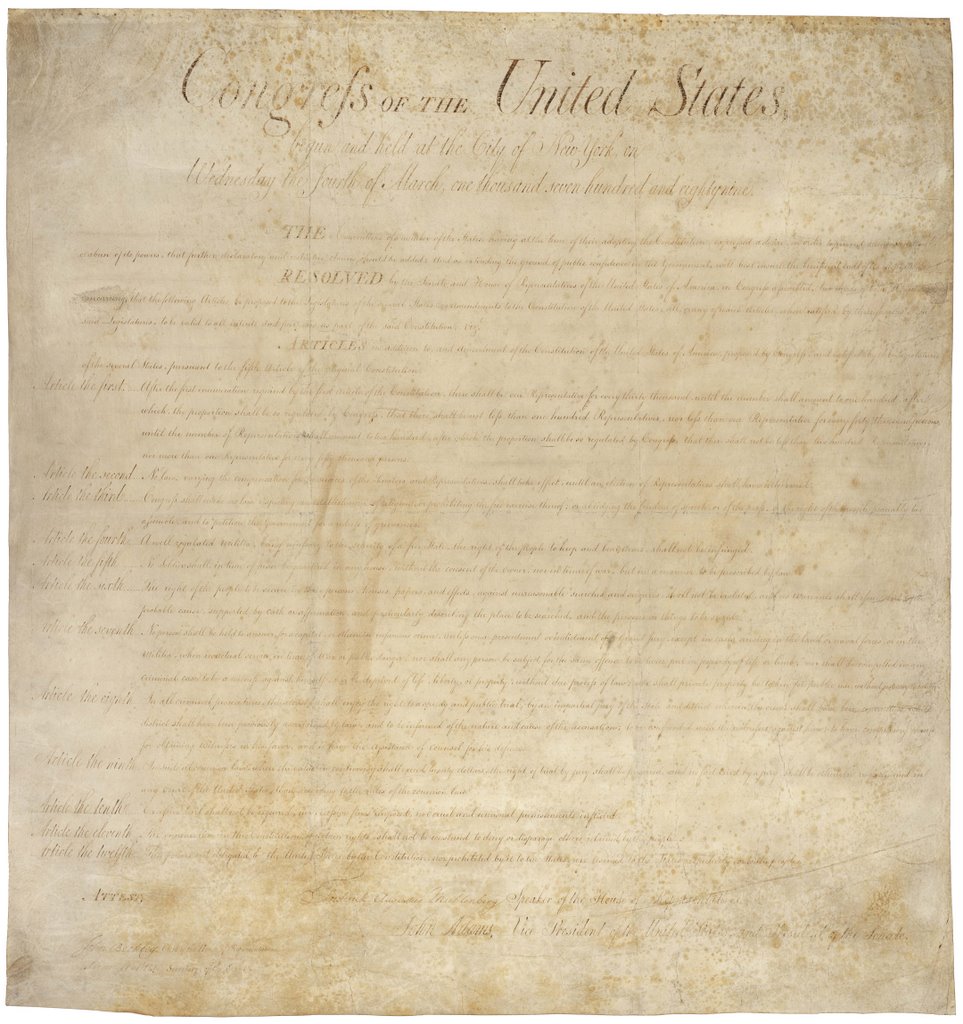
As many of you know, on September 25, 1789 the 1st Congress introduced 12 — not 10 — amendments to the states as the Bill of Rights.

The original 2nd Amendment — barring Congress from granting itself immediately effective pay raises — became the 27th Amendment on May 20, 1992. However, the original 1st Amendment was only ratified by 11 states — 2 shy of passage at the time. Since Coleman v. Miller makes clear that all amendments are considered pending before the state indefinitely unless Congress establishes a deadline within which the states must act, only 27 states are now needed to ratify this amendment for its passage. Hey 27 states, pass the original 1st Amendment.

If passed, the Congressional Apportionment Amendment would establish guidelines for the size of the House of Representatives. The Amendment’s math is a little hazy, but it ends with this important instruction: "there shall not be . . . more than one Representative for every 50,000 persons."

With a present US population of more than 300 million people, this introduces the possibility of a 6,000-member House of Representatives. I know I speak for everyone here when I say that if there’s one thing that the august body of the House needs to be truly effective, it’s to have 5,565 members added to its ranks.


In closing, Area #3 is really a pledge:

AREA #3: We pledge from this day forth that we shall write like the authors of our Constitution.

Not only shall we employ capitalization seemingly at random and use either British, tortured, or inconsistent spelling whenever possible, but — like the Constitution’s signatories — we shall sign our name to documents using absurd abbreviations.

I mean, why grace the document with your full name — it’s only a Constitution? These people, these founders, signed the Constitution with all the formality of someone signing a traffic ticket. William Blount went with the predictable "Wm." but William Livingston chose the path of a hipster, abbreviating "Wil:" Jonathan Dayton became "Jona:" Robert Morris became "Robt." . . . and anyone who has studied with Professor Hamburger will know who I’m talking about when I tell you that one of them merely signed "Gouv."

5 of the signatories determined that their signatures constituted little micro-sentences, worthy of ending with a period. We, too, shall end our signatures with periods. From this day forward, if you see a document signed "And: Brad:." know that it is me.


As you can see folks, our points of agreement are broad and substantial. So here’s to our agreements and our differences, here’s to our faculty and our constitutional societies, and here’s to the wig-and-tight-pants-wearing founders who made it all possible. Cheers!

Friday, January 12, 2007

Virginia Wasn't The Only Place That Wasn't For Lovers

(Crossposted from the American Constitution Society :: Columbia Law School)

It's easy to be hard on Virginia for having an anti-miscegenation statute in 1967.

It's easy to forget that it wasn't alone.


Source: Loving v. Virginia, 388 U.S. 1, 6 n.5 (1967).

Sunday, November 19, 2006

Failed Amendments We Have Known & Loved

(Crossposted from the American Constitution Society :: Columbia Law School)

Barring an unexpected Lame Duck attempt to amend the U.S. Constitution, Democratic control of Congress will probably result in a temporary moratorium on proposed amendments to the Constitution that would ban gay marriage or ban burning Old Glory.

Of course, the G.O.P. does not have a monopoly on converting a Congressional majority into failed attempts to amend the Constitution. During the next 2 years of their pending majority, if the Democrats need to find examples of entertaining failed attempts to amend the U.S. Constitution, history provides some real doozies.

In this post, we'll explore three prominent categories of failed Constitution amendments.

Zombie Amendments:
Approved, Not Ratified, No Expiration Deadline


Starting in the early 20th century, Congress began placing deadlines on the amendments it sent to the states for ratification. Typically, the states were given seven years to ratify an amendment. After the passage of the deadline, the proposed amendment would expire and Congress would need to start the process all over again to raise the issue. (In the past 50 years, two amendments expired after Congressional approval: the 1972 Equal Rights Amendment & the 1978 D.C. Voting Rights Amendment)

However, absent explicit sunset provisions, approved yet unratified amendments do not expire.1 Instead, they linger eternally, pending ratification. As shown with the 27th Amendment, an amendment which floated around for 200 years before finally being ratified in the 1990's, each of these amendments has the potential of becoming law.

Congressional Apportionment Amendment: This proposed amendment was the first of the original twelve amendments proposed to Congress (The original 2nd Amendment eventually became the 27th Amendment mentioned above). If passed, the amendment would have restricted the original size of the House of Representatives to 100 representatives, with later enlargements to be determined by Congress. From 1789 to 1792, 11 states ratified this amendment, leaving it two states short of ratification.

Titles of Nobility Amendment: Proposed in 1810, this amendment would strip U.S. citizenship from any citizen accepting, claiming, retaining, or receiving a foreign title of nobility without the consent of Congress.

Believed by some [See here and here. For a rebuttal, see here. (Apply salt liberally to the arguments on these web pages.)] to have been ratified and then supressed by a conspiracy of lawyers (who – so the theory goes – would lose their citizenship via their esquire title), this amendment was approved by 12 states, just one shy of full ratification. Since, at the time, it came within one house of the South Carolina legislature of being ratified, some 19th century printings of the Constitution erroneously include it as the 13th Amendment.2

Pro-Slavery Amendment: A last-ditch effort to avoid a civil war, this amendment – approved by the House and Senate on Februrary 28 & March 2, 1861, respectively – stated simply:
No amendment shall be made to the Constitution which will authorize or give to Congress the power to abolish or interfere, within any State, with the domestic institutions thereof, including that of persons held to labor or service by the laws of said State.
Apart from its subject matter, the language of this amendment raises an important issue in U.S. Constitutional theory: Can a Constitutional amendment prohibit a later amendment through an entrenched clause?

Although this amendment was ultimately ratified by Ohio and Maryland, neither legislature ratified it before the start of Civil War hostilities with the Battle of Fort Sumter on April 12, 1861.

Child Labor Amendment: Proposed in 1924 and ratified by 28 states, this still-pending amendment requires the approval of 10 more states in order to restrict to the federal government all power to regulate labor of persons under 18 years old.

This amendment is a direct reaction to the Child Labor Tax Case,3 which found Congress had overstepped the boundaries of the 10th Amendment with the scope of the taxes it placed on factories employing child labor.

Let's Remake America Amendments:
Ambitious Attempts to Change this Country

Had they been ratified, these proposed amendments would dramatically change the way our country works.No Way, José Amendments:
That's Just Crazy Talk

These proposed amendments were going exactly nowhere, but that's why we like 'em.

1 Coleman v. Miller, 307 U.S. 433, 454 (1939) (Finding that all amendments are considered pending before the states indefinitely unless Congress establishes a deadline within which the states must act.)

2 In Campion v. Towns, 2005 WL 2160115 at *1 (D. Ariz. 2005), a tax protester produced an 19th century archival copy of the Constitution incorrectly listing the Titles of Nobility Amendment as the 13th Amendment. Needless to say, the argument based on the existence of this document did not go very far with the Court.

3 Bailey v. Drexel Furniture Co., 259 U.S. 20 (1922)

4 354 U.S. 1 (1957)

Thursday, November 02, 2006

The Longest Case in U.S. History:
The Myra Clark Gaines Case

(Crossposted from the American Constitution Society :: Columbia Law School)

At the present moment (August, 1853) there is a suit before the court which was commenced nearly twenty years ago, in which from thirty to forty counsel have been known to appear at one time, in which costs have been incurred to the amount of seventy thousand pounds, which is A FRIENDLY SUIT, and which is (I am assured) no nearer to its termination now than when it was begun.
Charles Dickens, Preface to Bleak House (1853)

The case had been frequently before this court in various aspects; first, in 13 Peters, 404, then in 15 Peters, 9, 2 Howard, 619, 6 Howard, 552, 15 Howard, 473. In some of these reports large extracts are made from the record, illustrating the points of law and fact then under consideration, and also the evidence in support of them. All of this past history was brought again to the notice of the court in the argument of the present case, which cannot be again recited in the present report. The reader who wishes to understand all the points which are discussed in the opinion of the court must turn back to the preceding volumes above cited, and follow the case through its successive developments. He will then be able to appreciate the concluding remark in the opinion of the court, which is as follows:

"When hereafter some distinguished American lawyer shall retire from his practice to write the history of his country's jurisprudence, this case will be registered by him as the most remarkable in the records of its courts."
Gaines v. Hennen, 65 U.S. 553 (U.S. 1861) (reporter's note) (emphasis added).1
As he was writing Bleak House over the course of 1852 & 1853, Charles Dickens was aware of numerous cases mired for decades in the Courts of Chancery. Although his case of Jarndyce & Jarndyce was fiction, he knew the plodding reputation of the English courts at the time would make his case appear real to his 19th Century British audience.2

What Dickens probably did not know at the time, was that on this side of the Atlantic a woman named Myra Clark Gaines had already been pursuing a claim to an estate for almost twenty years.

What Dickens could not have known at the time was that the Gaines Case would continue for almost forty more years, becoming the longest case in the history of the U.S. judiciary. Her case, originally filed in 1834 would not be fully resolved until 1892, almost sixty years later.

Beginning with her first lawsuit in 1834 and culminating with New Orleans v. Whitney in 1891,3 the Supreme Court of the United States heard issues concerning the Gaines case an astounding sixteen times,4 and the Louisiana Supreme Court heard the case eight times.5

What was at issue in the Myra Clark Gaines Case?

For the answer, we turn to Elizabeth Urban Alexander's Notorious Woman: The Celebrated Case Of Myra Clark Gaines, a 300-page biography of Ms. Gaines published in 2001:
The events that formed the basis for the Gaines case began in 1787 when Daniel Clark arrived in New Orleans to join his uncle, Colonel Daniel Clark, in business. Ten years later, Colonel Clark conveyed all of his extensive property in Louisiana to his nephew, and at the age of thirty, Daniel Clark found himself one of the richest men in North America.

Clark's many business ventures brought him large revenues that he invested primarily in New Orleans real estate. During the early years of the nineteenth century, as he established himself in New Orleans as "a man of much personal pride and social ambition," Clark became romantically involved with a young Frenchwoman. All accounts of Zuileme Carrière emphasized her extraordinary beauty, vivacity, and charm, and both sides of the lawsuit admitted Clark's fascination with her.

Myra, daughter of Clark and Carrière, later came to believe that her parents had contracted a legal, though secret, marriage, making her the true heir to Clark's fortune. As she grew up, however, she was raised by friends of Clark and kept in ignorance of her real parentage as well as of her father's death in 1813, when she was nine.

Nearly twenty years afterward, Myra and her young husband arrived in New Orleans with a tale of a lost will and a claim that she was the true heir. Few believed her story. For the rest of her life, as a young wife and mother, as the third wife of a prominent general, and as a widow, Myra Clark Gaines pursued the vindication of her "rights."6
Besides its longevity, the Gaines case is legally interesting for a number of reasons. First and foremost, the Gaines case is a case about antebellum federal power — particularly about the scope of federal power in a state jurisdiction governed by civil law. Moreover, the case concerns the use of federal equity jurisdiction to govern a matter of domestic relations, an area where today's federal courts are loathe to exert their influence.7

Many of the appeals in the case reflect the reticence of courts sitting in Louisiana — even federal courts — to apply federal equity jurisprudence.8 The parties opposing Ms. Gaines (protecting the estate of her father) frequently argued before the court that equity had no place in Louisiana. In Gaines v. Chew, one of their many SCOTUS appeals, the estate administrators maintained that federal equity jurisprudence constituted "foreign law" inapplicable in the equity-free zone of Louisiana.9

In 1885, Ms. Gaines died, 6 years before the case came to its ultimate conclusion in her favor. After winning the final case before the U.S. Supreme Court the year before, on July 26, 1892, the administrator of her estate received a check for $923,788 from the city of New Orleans (which had received the Clark estate), ending the litigation.10 As you'd expect, creditors had significant claims against this sum, and little remained for the Gaines heirs to divide up.

If you want to know more about the Gaines case, I encourage you to check out Elizabeth Urban Alexander's Notorious Woman: The Celebrated Case Of Myra Clark Gaines or (if you don't want to leave the friendly confines of Westlaw or Lexis) check out Federalism's Fallacy: The Early Tradition of Federal Family Law and the Invention of State's Rights by Kristin L. Collins. 26 Cardozo L. Rev. 1761 (April 2005).


1 Justice James Moore Wayne – writer of the opinion cited by the above reporter's note – would die 6 years later in 1867, 24 years before the Myra Clark Gaines case would finally culminate in 1891.

2 Dickens not only succeeded in capturing the attention of a 19th Century British audience — he suceeded in capturing the attention of the modern U.S. judiciary. An unrestricted Westlaw search for "Jarndyce" among U.S. state and federal cases returns 254 results, including 3 SCOTUS references (most recently, Hartman v. Moore, -- U.S. ---, 126 S.Ct. 1695, 1701 (2006)

3 138 U.S. 595 (U.S. 1891)

4 U.S. Supreme Court Cases — Myra Clark Gaines
Ex Parte Whitney, 38 U.S. (13 Pet.) 404 (1837)
Gaines v. Relf, 40 U.S. (15 Pet.) 9 (1841)
Gaines v. Chew, 43 U.S. (2 How.) 619 (1844)
Patterson v. Gaines, 47 U.S. (6 How.) 550 (1848)
Gaines v. Relf, 53 U.S. (12 How.) 472 (1852)
Gaines v. Hennan, 65 U.S. (24 How.) 553 (1861)
Gaines v. New Orleans, 73 U.S. (6 Wall.) 642 (1868)
Gaines v. De La Croix, 73 U.S. (6 Wall.) 719 (1868)
Gaines v. Fuentes, 92 U.S. 10 (1876)
Smith, et al. v. Gaines, 93 U.S. 341 (1876)
Davis v. Gaines, 104 U.S. 386 (1881)
New Orleans v. Christmas, et al., 131 U.S. 191 (1889)
New Orleans v. U.S. ex rel. Christmas et. al.
, 131 U.S. 220 (1889)
New Orleans v. Whitney, 138 U.S. 595 (1891)

The district & circuit court cases involving Myra Clark Gaines are far too numerous to detail here, but information regarding them is available in the Bibliography of Elizabeth Urban Alexander's Notorious Woman: The Celebrated Case Of Myra Clark Gaines, the text of which is searchable at Amazon.com.

5 Louisiana Supreme Court Cases — Myra Clark Gaines
Barnes v. Gaines, 5 Rob. 314 (1843)
Succession of Clark, 11 La. Ann. 124 (1856)
Clark's Heirs v. Gaines, 13 La. Ann. 138 (1858)
De la Croix v. Gaines, 13 La. Ann. 177 (1858)
Van Wych v. Gaines, 13 La. Ann. 235 (1858)
Fuentes v. Gaines, 25 La. Ann. 85 (1873)
Foulhouze v. Gaines, 26 La. Ann. 84 (1874)

6 Elizabeth Urban Alexander, Notorious Woman: The Celebrated Case of Myra Clark Gaines 3 (2001)

If you're at Columbia Law School, the Arthur Diamond Law Libary has a copy of Notorious Woman available for checkout. Its call number is KF759.C57 A43 2001.

7 For a detailed analysis of the use of federal equity power in the Myra Clarke Gaines case, check out Federalism's Fallacy: The Early Tradition of Federal Family Law and the Invention of State's Rights by Kristin L. Collins. 26 Cardozo L. Rev. 1761 (April 2005)

8 Two of the Supreme Court appeals — Ex Parte Whitney, 38 U.S. (13 Pet.) 404 (1839) & Gaines v. Relf, 40 U.S. (15 Pet.) 9 (1841) — reversed lower federal courts sitting in Louisiana when those courts refused to apply equity to cases that they believed should have arisen under civil law, where equity was unavailable.

9 43 U.S. at 650 ("Complaint is made that the federal government has imposed a foreign law upon Louisiana. There is no ground for this complaint.").

10 The Gaines Case Settled; Some of the Claims to be at Once Paid by the Administrator, New York Times, July 27, 1892, at 1.

Monday, July 24, 2006

The Third Amendment: The Little Amendment That Couldn't

(Crossposted from the American Constitution Society :: Columbia Law School)

Stop what you're doing.

If you're a law student or a lawyer, the odds are pretty good that you're within easy walking distance of a copy of the U.S.C.A. Go to this multi-volume juggernaut.

The first umpteen volumes of this leather-bound behemouth are devoted to the U.S. Constitution and its amendments. Grab the volume dedicated to the first four amendments.

As you likely know, the U.S.C.A. is an annotated version of the codified statutes of the United States. Adjacent to a statute, the publisher (West) has attempted to include influential cases that reference that statute. Flip to the Third Amendment.

While flipping, you may have noticed that the First Amendment has about 150 pages of one-paragraph case synopses that illustrate how, over time, courts have interpretted the protections laid out in the First Amendment's 45 words.

If you flipped too far, you may have noticed the Fourth Amendment has about 400 pages of material dedicated to the constitutional protection against various unreasonable searches and seizures.

How many pages are devoted to the Third Amendment?

2

The republic is in its 230th year, with a constitution that is 217 years old. ...and yet there are 2 pages worth of cases that say anything interesting about the Third Amendment. Let's take a tour:

First, the text:

No Soldier shall, in time of peace be quartered in any house, without the consent of the Owner, nor in time of war, but in a manner to be prescribed by law.
Cornell's Annotated Constitution claims:
There has been no Supreme Court explication of this Amendment, which was obviously one guarantee of the preference for the civilian over the military. In fact, save for the curious case of Engblom v. Carey, 677 F. 2d 957 (2d Cir. 1982), on remand, 572 F. Supp. 44 (S.D.N.Y.), aff’d. per curiam, 724 F.2d 28 (2d Cir. 1983), there has been no judicial explication at all.
Au contraire. No fewer than seven cases have mentioned this sacred protective amendment, at least three of which bear mentioning.

First, back in the day of penumbras, a footnote in Katz v. US notes that this amendment protected at least one "aspect of privacy from governmental intrusion."1

Next, although the common law Ad Coelum rule (the rule's full name translates roughly as "To whomever the soil belongs, he owns also to the sky and to the depths.") was put out of commission 65 years before by Hinman v. Pacific Air Transport and its sister cases, the Custer County Action Association still forwarded an Ad Coelum-related theory in its 2001 case.2 The association claimed that peacetime military overflights were a per se unconstitutional quartering of soldiers on their property.3 Needless to say, the 10th Circuit disagreed rather heartily.

Finally, the last case bearing mention is Engblom v. Carey, which (as the quote above notes) is probably the only lengthy judicial discussion of the Third Amendment.4 Although I agree with Engblom's core holding, that National Guardsmen are "soldiers" within the meaning of the Third Amendment, I must sheepishly disagree with one of Engblom's other holdings — that the Third Amendment applies to the states via incorporation in the Fourteenth Amendment.5

Notwithstanding Barron v. Baltimore,6 it appears to me that the Third Amendment applies directly to state militias (given the National Guard's formation via the Militia Act of 1903, I'm treating them as state militias for the purpose of this argument.)

Article I, Section 10, Clause 3 reads:
No State shall, without the Consent of Congress, lay any Duty of Tonnage, keep Troops, or Ships of War in time of Peace, enter into any Agreement or Compact with another State, or with a foreign Power, or engage in War, unless actually invaded, or in such imminent Danger as will not admit of delay. (emphasis added)
Since a state could not maintain soldiers other than with the approval of Congress, since the Third Amendment says "No Soldier," not "no federal soldier," and since the Third Amendment provides a logical backstop to the militia power defined in the Second Amendment, it appears to me that the Third Amendment would have logically applied to the states before the Fourteenth Amendment made it so.


1 Katz v. US, 389 U.S. 347, 351 n.5 (1967).

2 Hinman v. Pacific Air Transport, 84 F.2d 755 (9th Cir. 1936); cert. denied, 300 U.S. 654 (1937); see US v. Causby, 328 U.S. 256, 261 (1946) (acknowledging that while a Fifth Amendment remedy might exist if flights over private property directly and immediately interfere with the enjoyment and use of the land, Congress has declared "[t]he air is a public highway" and "[c]ommon sense revolts at the idea" that aircraft operators would be subject to trespass suits based on common law notions of property ownership extending to the periphery of the universe). Black's Law Dictionary (6th ed 1990).

3 Custer County Action Ass'n v. Garvey, 256 F.3d 1024, 1042-43 (10th Cir. 2001).

4 Engblom v. Carey, 677 F.2d 957 (2d Cir. 1982), on remand 572 F. Supp. 44 (S.D.N.Y. 1983).

5 Id. at 961-62.

6 Barron v. Baltimore, 32 U.S. 243 (1833) (determining that the Bill of Rights did not apply to state governments)

(Thanks to Colin for the U.S.C.A. tip)

ABA to Executive Branch: "The Constitution is not what the President says it is."

(Crossposted from the American Constitution Society :: Columbia Law School)

An ABA task force is urging Congress to pass legislation permitting court review of presidential signing statements.

Although the Justice Department claims that President Bush has only issued 110 signing statements (to Clinton's 80 such statements), the ABA task force cites research that Bush has challenged the constitutionality of 800 provisions of law passed by Congress.

Friday, April 14, 2006

What Did You Just Sign to Me?!?!

Today, while I was studying in a coffee house, a person set a card on my table which said the following:

Hello!
I am a Deaf Person
I am selling this...
Deaf Education System Card
...to make my living and to support my family
Would you kindly buy one?
Pay any price you wish. Thank You! (Over)

On the back was the American Manual Alphabet for the Deaf and the ASL sign for I Love You.

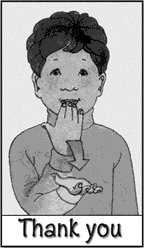
I gave the person $1. As I looked up at him, he made the ASL sign for Thank You — a common sign that I immediately recognized. However, this time, I realized that this sign bears a dangerous resemblance to another hand sign.

Why-oh-why did the well-intentioned innovators of ASL create a Thank You sign that so closely resembles Scalia's Sicilian Gesture?


I just hope that this resemblance has never brought about the misunderstanding and tragedy that it so clearly threatens.

Saturday, April 08, 2006

U.S. News Law School Rankings: The Harriet Miers Effect

(Crossposted from the American Constitution Society :: Columbia Law School)

Although it did not surge forward as much as University of Denver's Sturm School of Law (from #95 to #70) or Seton Hall (from #83 to #70), Harriet Miers's JD alma mater, the Southern Methodist University, tied for 3rd largest positive gain in the rankings, moving up 9 slots from #52 to #43.

2007 U.S. News Rankings
2006 U.S. News Rankings

Click here to view older rankings.

Monday, March 13, 2006

Illinois Senate Bill 2724: An Irrelevant Electoral College? (Part II)

(Crossposted from the American Constitution Society :: Columbia Law School)


(For Part I of this story and Andy's personal beef with the electoral college system, click here.)

Instead of personally characterizing Illinois Senate Bill 2724, I'll leave that task to Hendrik Hertzberg, who wrote about the bill for the New Yorker:

Here's how the plan would work. One by one, legislature by legislature, state law by state law, individual states would pledge themselves to an interstate compact under which they would agree to award their electoral votes to the nationwide winner of the popular vote. The compact would take effect only when enough states had joined it to elect a President — that is, enough to cast a majority of the five hundred and thirty-eight electoral votes. (Theoretically, as few as eleven states could do the trick.) And then, presto! All of a sudden, the people of all fifty states plus the District of Columbia are empowered to elect their President the same way they elect their governors, mayors, senators, and congressmen. We still have the Electoral College, with its colorful eighteenth-century rituals, but it can no longer do any damage. It becomes a tourist attraction, like the British monarchy.
The effort is called National Popular Election, and it has the support of The Center for Voting & Democracy, the leader in US election reform.

As the Per Curiam opinion in Bush v. Gore, 531 U.S. 98 (2000), notes, "the State legislature's power to select the manner for appointing electors is plenary; it may, if it so chooses, select the electors itself, which indeed was the manner used by State legislatures in several States for many years after the Framing of our Constitution." If this 6-year old statement even remotely reflects the current sentiment on SCOTUS, the National Popular Election effort would easily withstand constitutional scrutiny.

Here's hoping that enough states exercise this plenary power in such manner as to give voice to the will of the national electorate. The Illinois bill is currently in committee. Keep your fingers crossed. Your vote for the President may count soon enough.