Maggie Welcomes 2007
Maggie the Beagle wishes you all a joyous 2007!
Best,
Andy
Categories:
various and sundry

Maggie the Beagle wishes you all a joyous 2007!
Best,
Andy
Categories:
various and sundry
Then again, I'm not the most powerful person in the the world.
As reported by the New York Times:
Hussein's execution was widely reported (here and in Iraq) at 6:10 am Baghdad time, which is 9:10 pm Crawford, Texas time. In 2004, President Bush fell asleep during the first half of the Super Bowl, missing the Janet Jackson brouhaha.At President Bush’s ranch in Crawford, Tex., a White House spokesman, Scott Stanzel, said Mr. Bush had gone to bed before the execution took place and was not awakened. Mr. Bush had received a briefing from his national security adviser Friday afternoon, when he learned the execution would be carried out within hours, Mr. Stanzel said. Asked why Mr. Bush had gone to sleep before hearing the news, he said Mr. Bush “knew that it was going to happen.”
Categories:
POTUS and co.,
war on tara
I'm never too surprised when I venture into a personally-unexplored part of New York and stumble upon something wonderful or strange.
While heading to get our knives sharpened at an odd little shop on 30th street, I happened upon the old 23rd precinct station house, built in 1908 in the style of a fortress.
Categories:
art and design,
new york
 You know finals are here when tempting eat-up-your-time-in-big-bites web-based video games just reveal themselves to you.
Enter Word Shoot, a flash-based game where you protect yourself from your relentless opponents by spelling their names. Text entry hasn't been this fear-based since Giraffe, the falling letter game that ships with Palm PDAs.
Categories:
language
As has been covered extensively in the news, South Dakota Senator Tim Johnson has very recently undergone surgery to deal with a brain hemorrhage. Were Johnson to resign his post before the new session convenes, functional control of the Senate would likely return to the GOP (the Republican governor of South Dakota would likely nominate a Republican as a replacement, leading to a 50/50 split, with VP Cheney as a tiebreaker).
While some conservative commentators hover ghoulishly over the stricken Senator Johnson, a guest on NPR's NewsHour program reminds us of California Senator Clair Engle, who did not resign his position as his brain cancer progressed:
On June 10, 1964, during the roll call for the historic, successful effort to break the filibuster on what would become the Civil Rights Act of 1964, when the clerk reached "Mr. Engle," there was no reply. A brain tumor had robbed Senator Engle of his ability to speak. Slowly lifting a crippled arm, he pointed to his eye, thereby signaling his affirmative vote ("aye"). Few who witnessed Engle's brave act forgot it. Nine days later the Senate approved the act itself—producing one of America's towering 20th century legislative achievements.Senator Engle died a month and a half later.
Categories:
politics
Sometime reader of this blog and fellow Columbia Law student CSK has conducted a bit of a holiday investigation:
Andy,I suspect that the inclusion of all these terms on my blog will change the context-sensitive Google Ads on this page through the end of the year.
As we approach the holiday season, I thought I'd investigate the various spelling of the Jewish holiday. I have found four common binary variations: Ch/H, n/nn, k/kk, and a/ah. The following is a list of the sixteen permutations, in order of the number of results from a Google search of each permutation.
Perhaps readers of your blog would appreciate this analysis?
Hanukkah — 12,100,000
Chanukah — 3,400,000
Hanukah — 1,010,000
Hannukah — 790,000
Chanuka — 545,000
Hanuka — 518,000
Channukah — 437,000
Chanukkah — 315,000
Chanukka — 301,000
Hanukka — 107,000
Hannuka — 62,500
Hannukkah — 44,200
Channuka — 18,800
Channukka — 1,750
Hannukka — 821
Channukkah — 741
Note that Microsoft Word reports that all but the top three spellings are incorrect.
CSK
Working hard, aren't you?
The two variables about which I feel most strongly are the doubled consonants. The correct answer: one N, two K's. In proper Hebrew pronunciation, the kaf is doubled because it contains a dagesh chazak. In other words, the word would be broken into syllables as ha-nuk-kah rather than ha-nu-kah. (Several other Hebrew loan words are spelled with doubled consonants for the same reason - e.g. sabbath, hallelujah.) Granted, since most people don't pronounce dagesh chazak properly any more, I suppose it's reasonable to write only one K. The thing that's definitely wrong, though, is two N's. I'd guess that those spellings come largely as a result of people remembering that there's a doubled consonant but getting the wrong one.
As to the H vs. CH, question, obviously H with a dot underneath is the most ideal option, but that's hard to do on most word processors. I tend to use H here, but I admit that I sometimes use CH for het in some other contexts. If there's no option of having a dot, I'd say the CH is the best bet. Another spelling that occurs 1,290 times on Google is Khanuka (and variants), but I think it would be better to reserve KH for khaf and CH or H-dot (or h-bar!) for het. That distinction has been lost in Ashkenazi and modern Israeli Hebrew, but I'm pretentious that way. Another neat option is what Bryan/Aviel and other Sephardim do: Januk(k)a(h) (along with Pesaj).
As to the final H, it seems at first glance that the Hebrew spelling (with a hei) would mandate the H. However, a deeper analysis of Hebrew linguistics actually offers a rather compelling argument not to include the H. The details are too complicated to explain here, though.
(Crossposted from the American Constitution Society :: Columbia Law School) The American Family Association – worried that newly-elected Representative Keith Ellison (D-MN), who happens to be Muslim, will be sworn in with his hand on the Koran (instead of the Christian Bible) – is urging its members to do the following:
Never mind that Representatives don't place their hands on anything when they're sworn in en masse. How the AFA-proposed law wouldn't violate Article VI, Section 3 is beyond me:
- Send an email asking your U.S. Representative and Senators to pass a law making the Bible the book used in the swearing-in ceremony of Representatives and Senators.
- Forward this email to your friends and family today!
The Senators and Representatives before mentioned, and the members of the several state legislatures, and all executive and judicial officers, both of the United States and of the several states, shall be bound by oath or affirmation, to support this Constitution; but no religious test shall ever be required as a qualification to any office or public trust under the United States. (emphasis added)Too many more oversights like this and I'm going to stop turning to the American Family Association for my constitutional theory.
Categories:
constitution,
law,
politics,
religion
In 1993, the National Association of Collegiate Directors of Athletics (NACDA) established the Directors' Cup to reward the best overall NCAA Division I (other divisions & the NAIA were added 1995) athletic program in the country. North Carolina won the first Directors' Cup in 1993-94; however, the twelve subsequent Division I cups have been won by my alma mater, Stanford University.
On November 1, the NACDA announced a new scoring methodology for the contest. At first glance, the new rules – scoring both indoor/outdoor track, scoring all sports for which the NCAA/NAIA offers a championship (a change required by a new Program Philosophy) – do not seem to harm Stanford's chances of continued dominance in this contest. However, I can't help but wonder why the NACDA would change the rules other than to unseat Stanford University (and Williams College, which has won 10 of 11 Division III cups) from the top of the standings. (Also, note that UC Davis would likely still be winning the Division II award had it not started migrating sports to NCAA Division I in 2003.)
The original sponsor the Directors' Cup, Sears, ended its sponsorship of the contest in 2003. The present sponsor is a much less high profile organization (The U.S. Sports Academy). Although I don't know why Sears terminated its relationship with the program, the annual standings for the contest tell the tale: No one cares about the Directors' Cup, for the end result is almost always the same. Since the contest appears practically predetermined, the media ignores it. Why would a retailer throw advertising dollars at a contest sponsorship when ESPN et al. do not amplify those dollars through coverage of the contest?
Don't get me wrong: I'm a Stanford partisan, and I grin a big, provincial grin whenever Stanford wins any contest. Yet, whether it be through a rule change or a rough year, it's clear that their string of consecutive Directors' Cups cannot last. If Stanford & Williams continue their dominance unabated, I wouldn't be surprised to hear one day that the NACDA has decided to stop expending energy and resources on tabulating a contest that is not a contest.
A Parting Note: The reality is that collegiate athletic programs change very little from one year to another, so it's not surprising that the same affluent school, interested in investing in teams in each and every arcane varsity sport, would win every year. Maybe the NACDA is taking advice from U.S. News & World Report, whose overall collegiate rankings appear to be based on a methodology that changes every year, even if the data measured (the excellence of one school compared to another) do not.
Categories:
sf bay area,
the sporting life
(Crossposted from the American Constitution Society :: Columbia Law School)
There are many reasons for Congress to consider legislation. One of the primary reasons for Congress to consider legislation is that it believes that the judiciary will not find the subject matter of the statute already protected by the Constitution. Last Thursday, Lame Duck Virginia Senator George Allen proposed SB 4057, tentatively titled The National Park Second Amendment Restoration and Personal Protection Act of 2006. According to the current description of the bill, it would "protect the second amendment rights of individuals to carry firearms in units of the National Park System." If passed, it would permit a properly licensed individual to carry a concealed weapon in a National Park.
Of course, the bill's title and short description do nothing other than to obscure the bill's point and confuse debate. The Second Amendment doesn't grant you the right to carry a concealed weapon in the National Park System. That's why you're proposing this law.
Categories:
constitution,
law,
politics
(Crossposted from the American Constitution Society :: Columbia Law School)
Barring an unexpected Lame Duck attempt to amend the U.S. Constitution, Democratic control of Congress will probably result in a temporary moratorium on proposed amendments to the Constitution that would ban gay marriage or ban burning Old Glory.
Of course, the G.O.P. does not have a monopoly on converting a Congressional majority into failed attempts to amend the Constitution. During the next 2 years of their pending majority, if the Democrats need to find examples of entertaining failed attempts to amend the U.S. Constitution, history provides some real doozies.
In this post, we'll explore three prominent categories of failed Constitution amendments.
 Zombie Amendments:
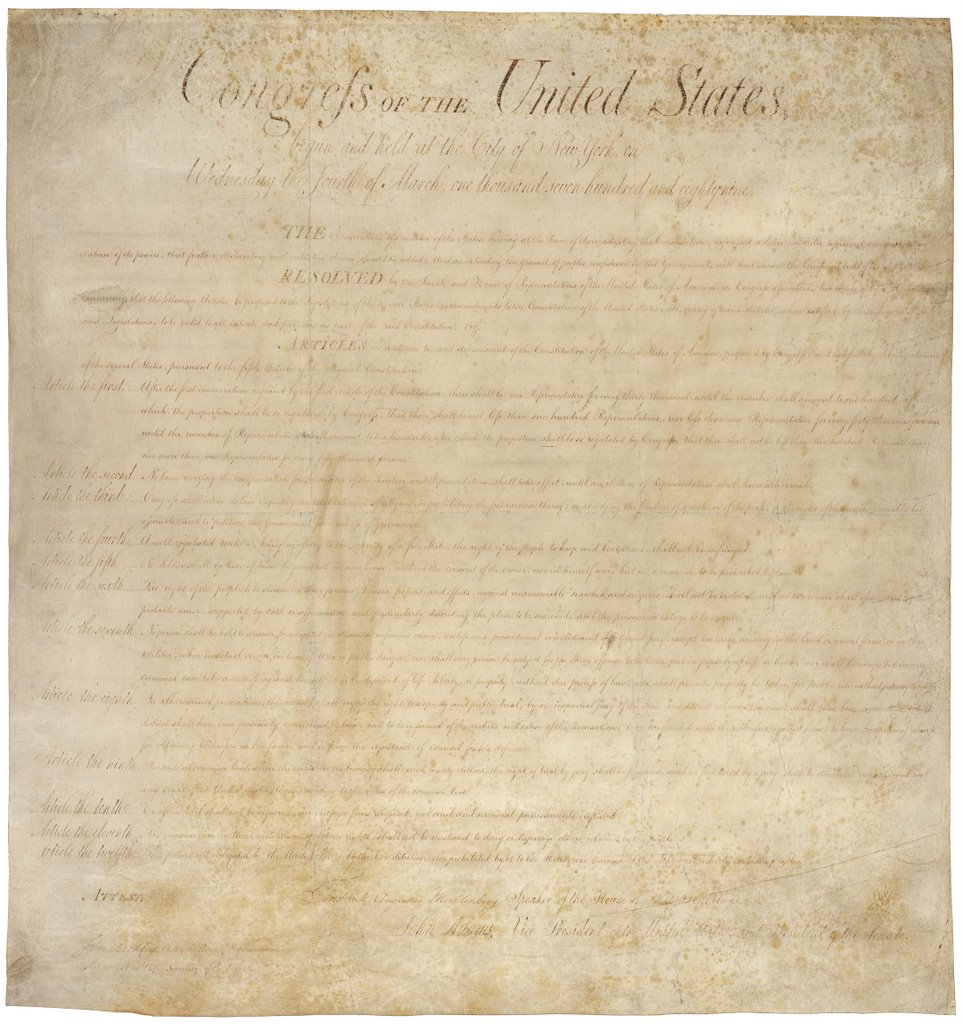 Congressional Apportionment Amendment: This proposed amendment was the first of the original twelve amendments proposed to Congress (The original 2nd Amendment eventually became the 27th Amendment mentioned above). If passed, the amendment would have restricted the original size of the House of Representatives to 100 representatives, with later enlargements to be determined by Congress. From 1789 to 1792, 11 states ratified this amendment, leaving it two states short of ratification.
No amendment shall be made to the Constitution which will authorize or give to Congress the power to abolish or interfere, within any State, with the domestic institutions thereof, including that of persons held to labor or service by the laws of said State.Apart from its subject matter, the language of this amendment raises an important issue in U.S. Constitutional theory: Can a Constitutional amendment prohibit a later amendment through an entrenched clause?
 Child Labor Amendment: Proposed in 1924 and ratified by 28 states, this still-pending amendment requires the approval of 10 more states in order to restrict to the federal government all power to regulate labor of persons under 18 years old.
H. J. RES. 14 — Proposing an amendment to the Constitution of the United States relative to abolishing personal income, estate, and gift taxes and prohibiting the United States Government from engaging in business in competition with its citizens.Yeah... Good luck with that one, Mr. Paul.


