Call Me Crazy, But I Don't Think You Need to Define That
Sometimes when lawyers start defining terms, they don't know when to stop.
Witness § 416(i)(2) of the tax code:
Categories:
law

Sometimes when lawyers start defining terms, they don't know when to stop.
Witness § 416(i)(2) of the tax code:
Categories:
law
One of my friends has a strange job. He works for a broadcast television network, crafting obituaries for people who are still alive. Now, as I try to cobble together a few words on Richard Rorty, the person who changed the way I see the world more than anyone else (outside my family), I realize why they write these things ahead of time.
I'm going to write about the second time Richard Rorty changed my life.
The first time, it was 1998 and I was a college senior taking a year-long course from Rorty during his first year at Stanford. The course listing indicated that by taking the class I'd get the chance to reacquaint myself with the Western canon. Instead, what I learned was that I wasn't the only person who cherished religion without living a life of belief, that a school of thought called pragmatism echoed many of the ideas I'd stumbled across in philosophical Taoism & Buddhism, and that Theodore Roosevelt more or less captured the meaning of life when he said "Do what you can, with what you have, where you are." (In class, I once asked Rorty what he felt the meaning of life was. I distinctly recall his answer: "To envisage new modes of being." Let's stick with Roosevelt.)
That was the first time. This is the second time:
The last time I had a long talk with Richard Rorty was October 2001. I was a struggling entrepreneur, back at Stanford half-time to finish my masters degree while the company I helped found was itself foundering (It would miraculously recover). I was taking a graduate course with Rorty – I think it was called Kant, Nietzsche, & Heidegger – and I paid him a visit in his office. I remember the conversation like it was yesterday.
As it was early October 2001, we started the conversation the way all conversations began in early October 2001. We talked about 9/11.
I asked Rorty if he'd written anything about 9/11. He said that he had not, but that he suspected American culture would react to this shock the same way it had reacted to similar shocks before — with xenophobia and a temporary loss of civil liberties. I was still in my post-9/11 complacency. Rorty was not.
Rorty was unflaggingly patriotic but despised chauvinism, recognizing that it's the latter that passes for patriotism today. In his brief 1994 essay The Unpatriotic Academy, Rorty (a lifelong leftie) criticized his fellow academic lefties, expounding a view that others would later condense into the t-shirt/bumper sticker slogan Dissent is Patriotic:
There is no contradiction between such identification and shame at the greed, the intolerance and the indifference to suffering that is widespread in the United States. On the contrary, you can feel shame over your country's behavior only to the extent to which you feel it is your country. If we fail in such identification, we fail in national hope. If we fail in national hope, we shall no longer even try to change our ways.The obligatory 9/11 discussion out of the way, we moved on to other matters.
Categories:
favorites,
law,
law school,
the way forward
(Check here for Part I of this post, and click here for Part II.)
Part I of this post argued that the EPL is worth your time and attention. Part II helped guide you away from 19 EPL teams not quite worth your fandom. Now, it's time for me to convince you, probably-a-Yankee blog reader, why you should be a Fulham fan.
In the spirit of full disclosure, I must admit up front that my wife's friend's boyfriend plays for Fulham. Naturally, you understand that this 3-degrees-of-separation relationship makes it more difficult, not easier, for me to be a Fulham fan.
First, football players move around a lot, and there are no guarantees that this guy will be playing for Fulham in the fall. Because of a new global television deal, EPL teams will receive a massive influx of cash next year. As a result, Fulham – like many other teams in the league – is cleaning house in anticipation of purchasing players away from other domestic leagues. He's still a Cottager (Fulham's stadium is called Craven Cottage, and thus the players are sometimes called "Cottagers."), and I expect him to be a Cottager in the fall. But I won't hold my breath.
Second, rooting for a sports team because your wife's friend's boyfriend plays for them sounds an awful lot like a man crush. With professional male sports leagues standing as the last conspicuous bastion of rank homophobia within mass culture, fandom based on a foundation of mancrushery simply would not do.
Now that you've waded through pages and pages of preamble, it's finally time for the final list of...
Categories:
favorites,
the sporting life
(Click here for Part I of this post, click here for Part III.)
Now that you've decided the EPL is worth your attention, it's time to choose your team. We start with 20 teams.
New Fan: "Hey, I picked my favorite baseball team."These teams have better players and spend drastically more than the rest of the league. The result is that they are too good relative to the other squads and should be promoted to some kind of intergalactic football league. Cheering for them is like cheering for Goliath.
You: "Oh yeah? What team did you pick?"
New Fan: "The All-Star Team"
You: "..."
Categories:
favorites,
the sporting life
(Check here for Part II of this post, and click here for Part III.)
This time a year ago, I couldn't have told you that it's a sleepy time of the year for soccer/football fans. I would have only the vaguest idea that the English Premier League – arguably the best domestic football league in the world – had wrapped up its games for the year. I probably couldn't have told you that there won't be many games until the domestic leagues start back up in August (this being a non-World Cup year).
You see, I'd been Tivoing the occasional English Premier League ("EPL") game for the past 4 years, but I didn't really care. Kind of like having a baseball game idly playing on the TV or radio during the summer, I found these games to be pleasant background noise while fussing about the house, doing chores. When I'd hear the fans roar as I was taking out the recycling, I'd come back to the living room to replay the goal. Something changed this season and I became vastly more interested in English soccer than previously. I'm not sure what prompted this bout of johnny-come-lately fandom. Perhaps this phenomenon is merely the flourishing of my long-budding Anglophilia, a condition nurtured by law school's frequent reference to the English heritage underlying our legal system. Whatever the cause, I'd Tivo all 5 live games available on the straightforwardly named Fox Soccer Channel, hyperwatching them on fast-forward later. I battled a restless night or two by perusing Wikipedia, learning about the various teams and traditions.
Halfway through this past season, I determined that this diffuse interest in the entire English top league would not do, and that I'd need to actively root for one team above all others to enjoy the sport more fully. A friend referred me to a piece written by the popular and silver-penned sportswriter Bill Simmons, who guided his readers on a similar journey at the start of last season (I won't spoil it by revealing his choice). Simmons (whose column on ESPN.com is probably the most widely read sportswriting in the US) prompted other web denizens to offer their odes to the EPL. This is my ode.
Yet, before I advance the argument made clear by this post's title, let me explain for a minute why you, probably-a-Yankee blog reader...
Categories:
favorites,
the sporting life
A big Sauntering welcome for Amos, who has agreed to link up with Colin & me in this little corner of the interwebsuperinfohighway. Amos's interests include long walks on the beach, justice and the American Way.
Categories:
omphaloskepsis
Given the myriad protocols governing interactions with members of the British Royal family, it was a given that President Bush was going to insult the Queen in one way or another during last night's state dinner.
Most journalists have focused on Bush's speech gaffe earlier in the day, where he implied the Queen was over 200 years old. At this point, Bush's malapropisms and oratory blunders should surprise no one, so I'm not sure why this most recent fumbling is even news.
More frustrating was this scene:
It appears that the head of the Executive Branch does not know Thing One about toast etiquette. To keep it simple, let's just review the culmination of the average toast:
Categories:
POTUS and co.
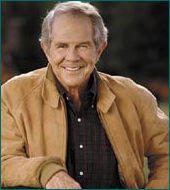 Mitt Romney, the presidential candidate prepared to believe whatever it takes to win the 2008 GOP nomination, just gave the commencement address at Pat Robertson's
Christian Broadcasting Network School of Law Regent "University." In his remarks, Romney noted Robertson's "dedication to strengthening and then nurturing the pillars of this community and our country."
Think Progress responded to Romney's Robertson shout-out by detailing a number of Robertson's positions and predictions.
Think Progress's list of notable Robertson statements is limited. For a larger set of Robertson foibles, check out this blog's Pat Robertson channel.
Categories:
pat robertson,
POTUS and co.
New York is a city of odd little neighborhoods, and you come to expect that you'll stumble upon something strange each time you venture into an unexplored part of the city. Visitors to Worth Street encounter a 500-foot tall windowless obelisk. If you live on 30th Street, you live next door to a police fortress.
Over these past few years, whenever out-of-town guests have visited us on 89th Street, I've been cheered to show them our strange wonder: The Claremont Riding Academy at 89th & Amsterdam, the last public stable in Manhattan. After 115 years of operation, it closes today.
In honor of the Claremont Riding Academy, I thought I'd share a reminiscence of my strange 89th street.
Walking down 89th Street between Riverside Park and Central Park is a visual and cultural treat. Starting at Riverside Drive, you encounter the first of two Jewish schools on my street, reminding you the Upper West Side is not only the most densely populated neighborhood in the United States, but also one of the most demographically Jewish neighborhoods outside of Israel. After passing a row of brownstones, another Jewish school, and 5 of the Upper West Side's ubiquitous 12/14 story apartment buildings, we arrive at 89th & Amsterdam.
If I could pick a phrase that best described Manhattan living for all of its residents, "Nobody Rides First Class on the Subway" would be an easy choice. The central difference between living in a varied urban setting and anywhere else I've visited is that rich & poor interact with (or are proximal to) each other to a far greater degree here than elsewhere. My street is a microcosm of Manhattan — 100 yards from the affluence of Broadway, and across the street from a building touting "Luxury Apartments," a 20-story public housing complex sits at the corner of 89th & Amsterdam.
Walking by this intersection during the summer means walking by a table or two of old men (and occasionally women) playing dominoes all day and into the evening, latin music on the portable radio, the whole scene having a certain Norman Rockwell quality to it. There was a gang-related murder here in broad daylight back in May 2006, reminding residents that things are not always just grand for those who live in public housing. But this is not a scary place. It strikes me that fear is usually just unfamiliarity, and these environs have become very familiar to me over the past couple years.
Also familiar, and soon to be missed, is the frequent sight of horses, walking single file down the street, either turning right on Amsterdam to head to Central Park via 90th street or returning from the park down 89th. Passing the stable during the day meant that there would usually be children inside, learning to ride. Each time we'd have a friend gaze through the open doors of the academy to view the trotting horses inside, we've enjoy watching a broad smile cross our friend's face. The reason someone standing in Manhattan loves the sight of these horses is the same reason that Central Park is so wonderful: To be in an urban environment, surrounded on all sides by concrete, and then to have just a glimpse of something wild or green or agrarian reminds you that the world is not yet entirely paved.1
Passing the stables, you come to the 1898 Gothic edifice of P.S. 166, The Richard Rogers School of Arts & Technology, the primary school where Jonas Salk, J.D. Salinger, and – naturally – Richard Rodgers (of Rodgers & Hammerstein) started their educations. The elaborate facade of P.S. 166 usually leaves me asking the same question that so many New York buildings instill in me: How stonemasons used to work in this city? How many are still here?
A few more apartment buildings and a row of brownstones and you've arrived at Central Park, just south of the 90th street gate. Like so many living in New York, I've grown attached to the little idiosyncrasies that differentiate my street from elsewhere in the city. As the Claremont Riding Academy closes its doors, I'm sad to see one of those points of distinction disappear.
Manhattan. Sometimes from beyond the skyscrapers,
across the hundreds of thousands of high walls,
the cry of a tugboat finds you in your insomnia
in the middle of the night,
and you remember that this desert of
iron and cement is an island.
Albert Camus, 1946
Categories:
new york
No reader of this blog will be surprised to hear that I consider myself to be a political & cultural liberal. Still, it's easy for me to identify a handful of conservative voices whom I treasure. Leading the pack are David Brooks (presently/formerly referred to as "every liberal's favorite conservative," NY Times columnist) and Andrew Sullivan (former editor of The New Republic, blogger, author of The Conservative Soul: How We Lost It, How to Get It Back).
Other than strong writing, the thread linking Sullivan & Brooks in my mind is a capacity to be critical of the broader political & cultural conservative movement. Surely part of the attraction of having a conservative criticize conservatism is that it saves liberals from doing all the work, but that's not the half of it.
A larger part of my attraction to these writers' work is their refusal to close ranks and stand shoulder-to-shoulder with other self-identified conservatives when doing so would require them to compromise their views. After what this country has recently been through, this is a trait all liberals should value.
I say nothing controversial at all when I say that many of the self-inflicted injuries wrought upon this nation during the past 6+ years have been exacerbated by dissenting or skeptical members of the controlling party/ideology either supporting or refusing to oppose decisions made by other party/ideology members. Fortunately for us, as frustrating and painful as this past historical period has been, it appears we're entering a new era with a different set of rules regarding toeing the ideological line.
The American voter's rejection last November of the conservatives-united-will-never-be-divided approach is starting to bear fruit, and public dissent among conservatives has returned to the public forum. Although this public conservative dissent is now no stranger to the airwaves, I wanted to cheer you with a less-known bit of conservative dissent that cheered me today.
A bit of back story: The Corner is a blog run by the National Review, a magazine founded by William F. Buckley in 1955 and lately accused by voices on the left of chickenhawking — that is, offering civilian commentary (from commentators who have never served in the military) in strong support of an aggressive interventionist military strategy. Of late, I've become a bit addicted to The Corner, if for no other reason than to learn more about how the current crop of neoconservatives see the world.
On the day after the Virginia Tech tragedy, and in the spirit of a true chickenhawk, one of the National Review bloggers, John Derbyshire, wrote a post blaming the victims of Monday's attack for the enormity of their own suffering. "Where was the spirit of self-defense here?" asked Derbyshire, wondering how a lightly armed person could kill so many. Apparently, Derbyshire was certain of his own courage when similarly situated.
Over the past four days, me-too conservative pundits have tried to reframe the debate about Derbyshire's words, engaging in all manner of apologetics and trying in vain to turn blaming the victims into something other than blaming the victims. Finally, today, another National Review blogger, John Podheretz, stood up to Derbyshire's accusation. "I have to dissent, in the strongest possible terms, from John Derbyshire's shocking posts on Virginia Tech," Podheretz began, launching into a blistering critique of his colleague's view.
I'm not accustomed to National Review writers dissenting amongst themselves in the "strongest possible terms," and I was well pleased — not pleased that I found one more conservative voice to consistently enjoy (JPod's not really my cup of tea), but that I witnessed a conservative voice stand up to another conservative voice when it would have been easier for him to attempt to excuse his colleague's poorly-conceived comments or just to look the other way.
Categories:
politics,
the way forward


